Apple Raises Quarterly Dividend 3.9% to $0.27
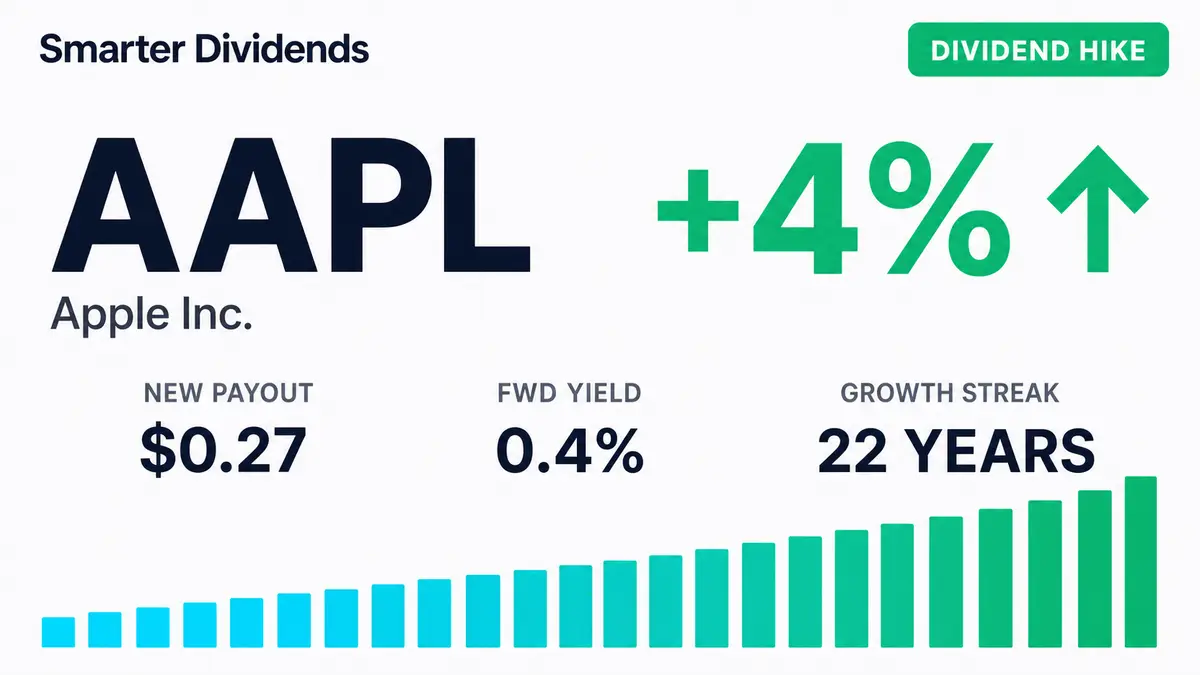
Apple raised its quarterly dividend 3.9% to $0.27 a share, extending its 22-year growth streak with a 12% earnings payout ratio and a 0.32% yield.
 AAPL — Apple Inc.
Key takeaways
- Apple raised its quarterly dividend 3.9% to $0.27 a share from $0.26.
- The new rate provides $1.08 a share annually, equal to $108.00 for 100 shares.
- The dividend has a 12% earnings payout ratio and an A safety grade with a score of 95.
- Apple’s 0.32% forward yield is below the Technology sector median of 1.38%.
Apple raised its quarterly cash dividend 3.9% to $0.27 a share from $0.26. The first payment at the new rate had an ex-dividend date of May 11, 2026. The increase lifts the annual dividend to $1.08 a share.
Why the dividend changed
Apple did not attribute the increase to a single factor. It announced the higher payment alongside record fiscal second-quarter performance, indicating that operating strength supported the board’s decision. Revenue rose 17% year over year to $111.2 billion, diluted earnings per share rose 22% to $2.01, and operating cash flow exceeded $28 billion. CFO Kevan Parekh said the quarter set March-period records for operating cash flow and earnings per share, while the active-device installed base reached a record across major product categories and regions. Apple’s second-quarter release reported those results.
The increase was a regular annual step, not the result of a stock split, merger, spin-off or special distribution. The board paired it with a new authorization to repurchase as much as $100 billion of common stock. Apple’s quarterly filing says the company intends to increase the dividend annually, subject to board approval, placing the raise within its standing capital-return policy rather than a one-time corporate event. Apple’s fiscal second-quarter Form 10-Q confirms the rate change and that policy.
The business continued to produce strong results after the increase. Fiscal third-quarter revenue rose 16% year over year to $109.4 billion, while diluted earnings per share rose 29% to $2.02, including a favorable $0.11 impact from tariff refunds. Apple also kept the quarterly dividend at $0.27. The company’s third-quarter results show the higher rate remained in place. Its latest Form 10-Q says cash, marketable securities, operating cash flow and access to debt markets are expected to support cash needs and the capital-return program.
Dividend track record
The payment sequence shows how Apple implements its increases. The dividend was $0.25 for the ex-dividend dates of November 8, 2024 and February 10, 2025, then moved to $0.26 for May 12, 2025 through February 9, 2026. It rose to $0.27 for May 11, 2026 and remained there for August 10, 2026. That pattern is consistent with an annual reset followed by quarterly payments at the prevailing rate.
Full-year totals have risen steadily. Payments totaled $0.81 a share in 2020 and $0.87 in 2021, an increase of 7.1%. The total then reached $0.91 in 2022, $0.95 in 2023, $0.99 in 2024 and $1.03 in 2025. The annual increases moderated from 5.2% in 2022 to 4.4% in 2023, 4.2% in 2024 and 4.0% in 2025. The direction remained positive even as the pace slowed.
Apple has 22 consecutive years of dividend growth, while its five-year record is 4.9% annual growth. The latest 3.9% increase is therefore close to the recent pace and slightly below the 2025 increase. The record describes a dividend designed to rise gradually rather than deliver large annual increases.
Is the dividend covered?
The dividend uses 12% of earnings. That means most reported profit remains after the common dividend, leaving a broad earnings cushion for operating needs, investment, repurchases and other claims on cash. Coverage is therefore strong on the earnings measure.
SmarterDividends rates the dividend A, with a safety score of 95. An A means very safe, the category for scores from 80 to 100. The grade is consistent with the low earnings payout ratio and Apple’s stated expectation that its liquidity and cash generation can fund the capital-return program, as described in its latest quarterly filing. It does not mean the payment is guaranteed, because each dividend still requires board approval.
Yield and valuation
The forward yield is 0.32%, compared with the Technology sector median of 1.38%. The gap shows that Apple offers materially less current income than the typical sector stock despite its long growth record. At $1.08 a share annually, 100 shares produce $108.00 in annual dividend income.
The shares trade at $336.15 after a 24.3% gain over one year. SmarterDividends estimates fair value at $181.00 and classifies the shares as overvalued, with 46% downside to that estimate. The combination of a high share price and a modest cash distribution helps explain the low forward yield. The valuation verdict is separate from dividend coverage: the dividend can be well covered while the stock trades above the fair-value estimate.
What to watch
Apple’s next earnings report will show whether operating momentum and cash generation remain consistent with its capital-return framework. Management guided for September-quarter revenue growth of 9% to 11% year over year, while flagging a 2.5 percentage-point sequential foreign-exchange headwind and greater supply constraints affecting iPhone, Mac and iPad. Those are the clearest near-term operating tests around the dividend backdrop. The guidance was given on Apple’s fiscal third-quarter earnings call.
Investors can also watch the next board declaration for confirmation that the $0.27 quarterly rate remains in force. The latest payment history contains two ex-dividend dates at that rate, May 11, 2026 and August 10, 2026. Beyond the next declaration, the central items are Apple’s reported operating cash flow, the impact of tariffs and supply constraints, and any update to the board’s capital-return authorization disclosed in its quarterly filing.
AAPL dividend data
From the SmarterDividends dataset, updated daily
- Forward yield
- 0.31%
- Payout ratio
- 12%
- Growth streak
- 14 yrs
- Safety grade
- A · 95/100
| Ex-dividend date | Amount | Change |
|---|---|---|
| Aug 10, 2026 | $0.2700 | +0.0% |
| May 11, 2026 | $0.2700 | +3.8% |
| Feb 9, 2026 | $0.2600 | +0.0% |
| Nov 10, 2025 | $0.2600 | +0.0% |
| Aug 11, 2025 | $0.2600 | +0.0% |
| May 12, 2025 | $0.2600 | +4.0% |
| Feb 10, 2025 | $0.2500 | +0.0% |
| Nov 8, 2024 | $0.2500 | +0.0% |
Frequently asked questions
How much is Apple’s new quarterly dividend?
Apple’s new quarterly dividend is $0.27 a share, up from $0.26.
How much did Apple increase its dividend?
Apple raised the quarterly dividend 3.9%.
How much is Apple’s dividend per year?
The annual dividend is $1.08 a share. That equals $108.00 in annual income for 100 shares.
Is AAPL’s dividend safe?
SmarterDividends rates Apple’s dividend A with a safety score of 95, meaning very safe. The dividend uses 12% of earnings.
What is Apple’s dividend yield?
Apple’s forward yield is 0.32%, compared with the Technology sector median of 1.38%.
Sources
See AAPL's full dividend profile
Yield, payout, safety score, history and the next ex-dividend date.
View AAPLEvery dividend increases this month, with the data behind it: Dividend Increases, June 2026.
More dividend news

Northpointe Bancshares Raises Quarterly Dividend 20.0% to $0.03
Northpointe lifts its quarterly dividend 20.0% to $0.03 per share, while a 4% earnings payout ratio signals ample reported profit coverage.
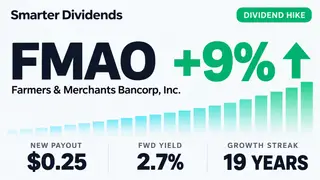
Farmers & Merchants Bancorp Raises Dividend Payment 8.7% to $0.25
FMAO's third-quarter payment rises 8.7% to $0.25, including a special dividend, while earnings and capital reinforce its long payout record.

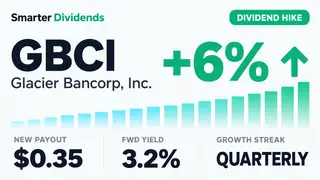
Glacier Bancorp Raises Quarterly Dividend 6.1% to $0.35
Glacier Bancorp lifted its quarterly dividend 6.1% to $0.35, while a 68% earnings payout ratio and B safety grade frame the payment's coverage.

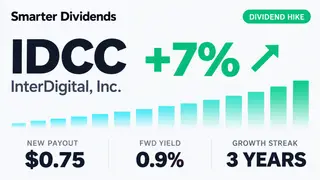
InterDigital Raises Quarterly Dividend 7.1% to $0.75
InterDigital raised its quarterly dividend 7.1% to $0.75, backed by a 32% earnings payout ratio, stronger licensing momentum and higher guidance.
Quaker Chemical Raises Dividend 4.3% to $0.53
Quaker Chemical raised its quarterly dividend 4.3% to $0.53, extending an 18-year growth streak as stronger earnings support coverage.