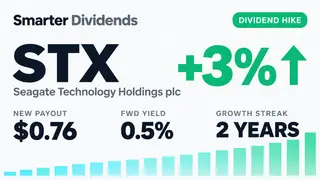
Pitney Bowes Raises Quarterly Dividend 11.1% to $0.10
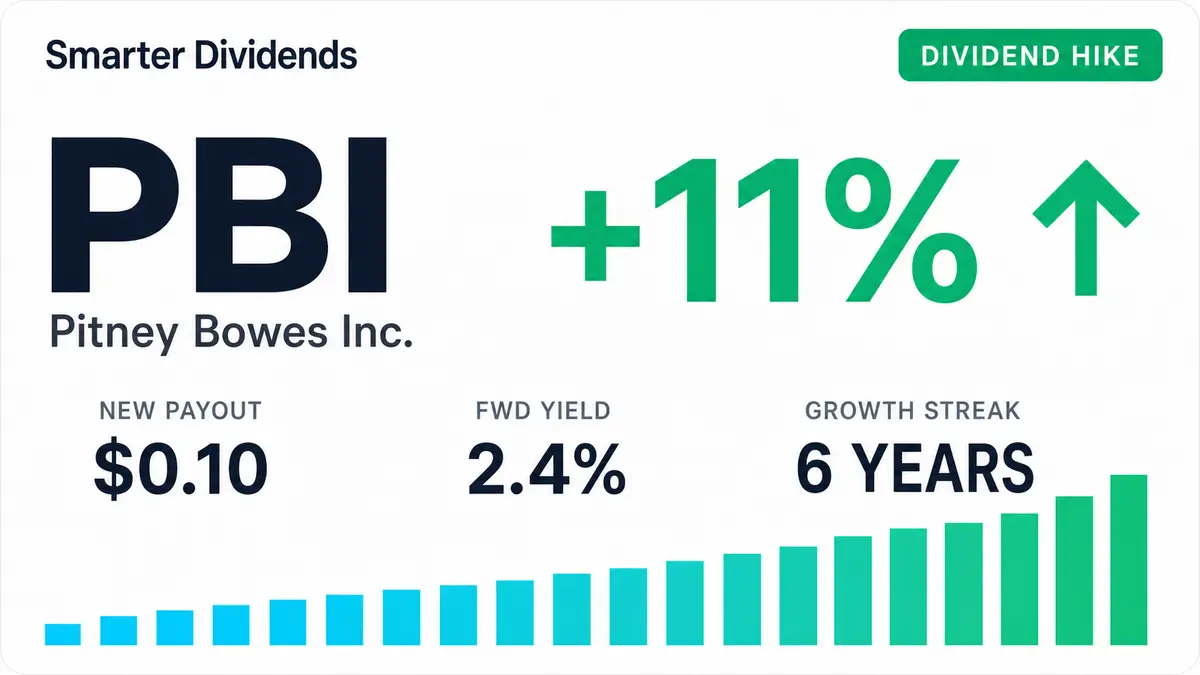
Pitney Bowes lifted its quarterly dividend 11.1% to $0.10 as stronger earnings, cash flow and debt reduction supported the higher payout rate.
 PBI — Pitney Bowes Inc.
Key takeaways
- Pitney Bowes raised its quarterly dividend 11.1% to $0.10 a share from $0.09.
- The annual dividend is $0.40, equal to $40.00 of annual income for every 100 shares.
- The dividend has a 29% earnings payout ratio and a B safety grade with a score of 77.
- The 2.46% forward yield exceeds the Industrials sector median of 1.61%.
Pitney Bowes Inc. raised its quarterly dividend 11.1% to $0.10 a share from $0.09, lifting the annual dividend to $0.40. Shares traded ex-dividend on May 18, 2026.
Why the dividend changed
Pitney Bowes did not give a single, standalone reason for the increase. The board announced it alongside first-quarter results that showed stronger profit and cash generation despite lower revenue. Revenue fell 3% to $477 million, but adjusted earnings per share rose 42% to $0.47. Free cash flow improved to $44 million from a use of $20 million a year earlier. The company also reaffirmed upgraded full-year guidance that called for adjusted earnings per share of $1.50 to $1.65 and free cash flow of $345 million to $380 million. Pitney Bowes’ first-quarter release
The increase also fits management’s stated approach to capital allocation. Chief Executive Kurt Wolf has described a policy balancing debt reduction, share repurchases, well-timed dividend increases and investment in the business. At the time of the declaration, Pitney Bowes had repurchased 17.2 million shares for $186 million during the year through May 1, after buying back 53.1 million shares for $565 million under its existing authorization. Pitney Bowes’ first-quarter release CEO letter on capital allocation
Later results strengthened that operating context. In the second quarter, adjusted earnings per share increased 59% to $0.43 and adjusted free cash flow rose 39% to $148 million. Pitney Bowes raised its full-year adjusted earnings and cash-flow guidance while reducing debt by $201 million from the end of the first quarter through July 29. SendTech profit benefited from cost reductions, although both SendTech and Presort revenue remained lower than a year earlier. Pitney Bowes’ second-quarter results
Dividend track record
The recent payment record shows a rapid rebuilding of the quarterly distribution. Pitney Bowes paid $0.05 with an ex-dividend date of November 18, 2024, followed by $0.06 on February 21, 2025, $0.07 on May 19, $0.08 on August 11 and $0.09 on November 10. The rate remained $0.09 for the February 27, 2026, ex-dividend date before moving to $0.10 for May 18 and August 10.
Full-year totals provide a longer perspective. Annual payments held at $0.20 from 2020 through 2024, then rose 50.0% to $0.30 in 2025. The dividend-growth streak stands at 6 years, and the five-year rate is 8.4% annual growth. The last annual cut occurred in 2019, so the recent increases represent a restoration from a lower base rather than an uninterrupted long-term record of rising payments.
Is the dividend covered?
The dividend consumes 29% of earnings. That payout ratio indicates earnings currently cover the distribution with room for retained profit, although coverage remains dependent on execution in businesses facing structural declines in physical mail volumes.
SmarterDividends rates the dividend B with a safety score of 77. That places the payout in the safe range of 66-79, reflecting a relatively moderate earnings payout and the company’s improving cash generation. The latest results reinforce that assessment: second-quarter adjusted free cash flow increased while management raised its full-year adjusted free-cash-flow outlook. Pitney Bowes’ second-quarter results
The grade does not remove the principal operating risks. SendTech continues to contend with erosion in its mailing equipment base, while Presort faces lower mail volumes, client losses and higher transportation costs. Those pressures matter because sustained earnings and cash flow fund the dividend alongside debt reduction, repurchases and business investment.
Yield and valuation
At a share price of $16.28, Pitney Bowes has a 2.46% forward yield. That compares with a 1.61% median forward yield for the Industrials sector. The $0.40 annual dividend produces $40.00 in yearly income for every 100 shares, assuming the rate remains unchanged.
The shares have recorded a 70.5% gain over one year. SmarterDividends estimates fair value at $18.47 and assigns a fair valuation verdict, equivalent to 10% upside from the stated share price. The yield remains above the sector median despite the share-price advance.
What to watch
The main financial markers are the updated 2026 outlook and the balance between capital returns and deleveraging. Pitney Bowes’ latest guidance calls for adjusted earnings per share of $1.55 to $1.70 and adjusted free cash flow of $360 million to $410 million. Investors can compare subsequent results with those ranges and monitor whether SendTech’s cost savings continue to offset revenue pressure and whether Presort stabilizes volumes and margins. Pitney Bowes’ second-quarter results
The board is also conducting the second phase of a strategic review covering acquisitions, divestitures, partnerships and a possible sale of the company. No deadline has been set, and Pitney Bowes has said the review may not produce a transaction or change in strategy. Any resulting action could alter the company’s business mix, balance sheet or capital-allocation priorities. Pitney Bowes’ strategic-review announcement
PBI dividend data
From the SmarterDividends dataset, updated daily
- Forward yield
- 2.31%
- Payout ratio
- 29%
- Growth streak
- 1 yrs
- Safety grade
- B · 79/100
| Ex-dividend date | Amount | Change |
|---|---|---|
| Aug 10, 2026 | $0.1000 | +0.0% |
| May 18, 2026 | $0.1000 | +11.1% |
| Feb 27, 2026 | $0.0900 | +0.0% |
| Nov 10, 2025 | $0.0900 | +12.5% |
| Aug 11, 2025 | $0.0800 | +14.3% |
| May 19, 2025 | $0.0700 | +16.7% |
| Feb 21, 2025 | $0.0600 | +20.0% |
| Nov 18, 2024 | $0.0500 | +0.0% |
Frequently asked questions
How much is the new PBI dividend?
Pitney Bowes’ new quarterly dividend is $0.10 a share, up 11.1% from $0.09. The annual dividend is $0.40 a share.
When did PBI trade ex-dividend for the increased payment?
The first $0.10 payment had an ex-dividend date of May 18, 2026. The next recorded $0.10 payment had an ex-dividend date of August 10, 2026.
Is PBI’s dividend safe?
SmarterDividends rates the dividend B with a safety score of 77, classified as safe within the 66-79 range. The earnings payout ratio is 29%.
What is Pitney Bowes’ dividend yield?
PBI’s forward dividend yield is 2.46%, compared with the Industrials sector median of 1.61%.
How long has Pitney Bowes increased its dividend?
The dividend-growth streak stands at 6 years, with 8.4% annual growth over five years. The last annual cut occurred in 2019.
Sources
See PBI's full dividend profile
Yield, payout, safety score, history and the next ex-dividend date.
View PBIEvery dividend increases this month, with the data behind it: Dividend Increases, June 2026.
More dividend news

Old Second Bancorp Raises Quarterly Dividend 14.3% to $0.08
Old Second lifts its quarterly dividend 14.3% to $0.08, with a 15% earnings payout ratio and an A safety grade after stronger quarterly results.
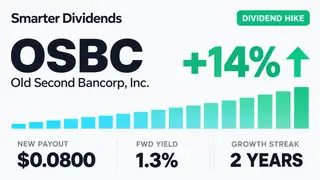
West Coast Community Bancorp Raises Dividend 16.0% to $0.29
West Coast Community Bancorp raised its quarterly dividend 16.0% to $0.29, extending a 5-year growth streak with an A safety grade and 1.83% yield.

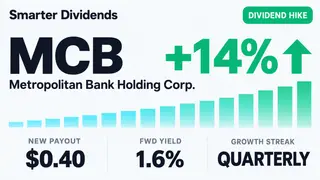
Metropolitan Bank Raises Quarterly Dividend 14.3% to $0.40
Metropolitan Bank lifts its quarterly dividend to $0.40 as stronger earnings, wider margins and solid capital support the latest payout increase.

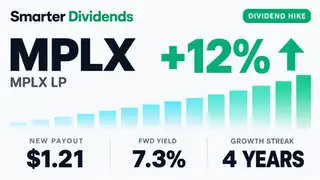
MPLX Raises Quarterly Distribution 12.5% to $1.2111
MPLX lifted its quarterly distribution to $1.2111 per unit, extending its growth streak as cash generation supports a larger capital return.

Seagate Raises Quarterly Dividend 2.7% to $0.76
Seagate raised its quarterly dividend 2.7% to $0.76 after record free cash flow, stronger demand and continued balance-sheet repair in cloud storage.