Conagra Brands (CAG) Cuts Dividend 50.0% to $0.175
Conagra Brands (CAG) cut its quarterly dividend 50.0% to $0.175, redirecting cash toward debt reduction, brand support and supply-chain investment.
 CAG — Conagra Brands, Inc.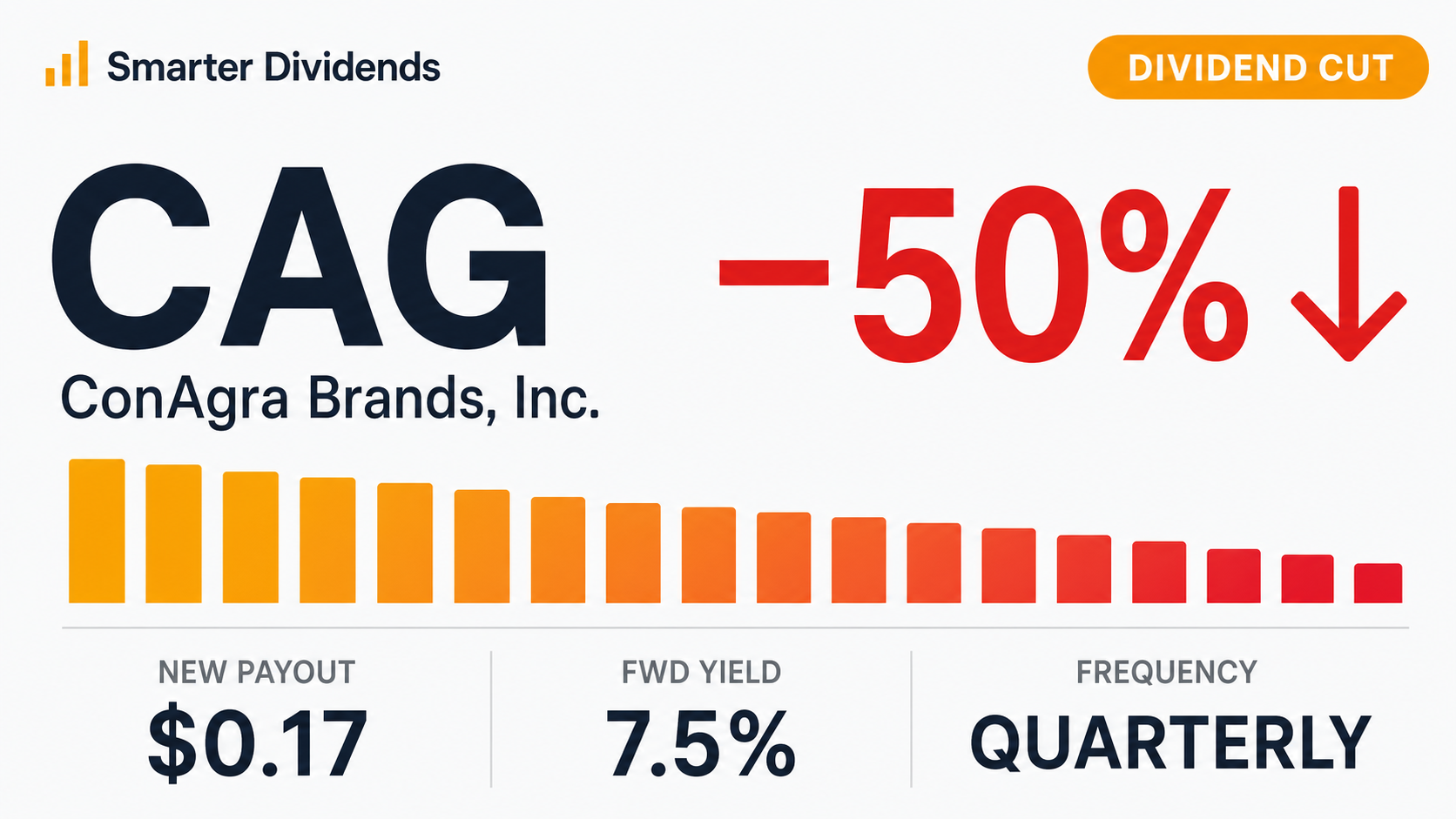
Key takeaways
- Conagra cut its quarterly dividend 50.0% to $0.175 per share from $0.35.
- The forward yield is 8.29%, compared with a 4.49% Packaged Foods industry median.
- The dividend has a 79% earnings payout ratio and a SmarterDividends safety score of 78, equivalent to a B grade.
- The growth streak is 0 years, although Conagra says it has paid consecutive quarterly dividends since January 1976.
Conagra Brands Inc. cut its quarterly dividend 50.0% to $0.175 per share from $0.35. The first reduced payment went ex-dividend on July 30, 2026, ending the company’s dividend-growth streak and halving the quarterly cash income generated by the same number of shares.
Why the dividend changed
Conagra presented the reduction as a capital-allocation reset, not an adjustment related to a stock split, merger or spin-off. Chief Executive Officer John Brase said the former allocation limited financial flexibility, while the business needed additional investment in its brands and supply chain. His four stated priorities were restoring margins, increasing investment, reducing organizational and portfolio complexity, and rebalancing capital allocation. Conagra’s fiscal 2026 earnings remarks show that management intends to direct more cash toward debt reduction, brand support, manufacturing modernization and potential portfolio changes.
The operating backdrop helps explain the decision. Fiscal 2026 net sales decreased 2.9%, organic net sales decreased 0.4%, and adjusted gross profit decreased 9.4%. Free cash flow fell to $979 million from $1.3 billion as lower operating profit outweighed better inventory management. Conagra nevertheless reduced net debt to $7.1 billion and finished the year with a 3.83 times net leverage ratio. The company’s fourth-quarter results also reported substantial non-cash goodwill and brand impairment charges, reflecting weaker projected sales and margins and higher discount rates. The fiscal 2026 Form 10-K identifies significant impairments in the Refrigerated & Frozen business and brands including Birds Eye, Armour, Bertolli, BOOMCHICKAPOP and Wish-Bone.
The fiscal 2027 outlook calls for organic sales to decline between 1% and 3%, adjusted operating margin of 10.0% to 10.5%, and adjusted earnings per share of $1.40 to $1.50. Management also expects elevated oil-related, logistics and animal-protein costs, as well as volume pressure from pricing actions. Capital expenditures are planned at approximately $550 million, with spending directed toward supply-chain modernization, insourcing and Project Catalyst. Management’s earnings remarks describe the lower dividend as a way to support those priorities while working toward a long-term leverage target of 3 times.
Dividend track record
The cut follows several years in which dividend growth had already slowed. Annual payments rose from $0.91 in 2020 to $1.18 in 2021, an increase of 28.7%. The total then rose 9.4% to $1.29 in 2022, 5.8% to $1.36 in 2023 and 2.9% to $1.40 in 2024. Payments remained unchanged at $1.40 in 2025, indicating that the expansion phase had ended before the reduction.
At the payment level, Conagra distributed $0.35 per quarter through the April 30, 2026 ex-dividend date. The amount fell to $0.175 for the July 30, 2026 ex-dividend date. The current consecutive annual-growth streak is therefore 0 years, and the last annual cut before this event occurred in 2006. The five-year record still shows 10.4% annual growth, but that backward-looking rate does not describe the reduced current payment.
Conagra distinguishes payment continuity from dividend growth. The company says it has paid consecutive quarterly dividends since January 1976, and its latest declaration maintained the reduced quarterly rate. That long payment record does not mean the dividend increased every year. Conagra’s latest dividend announcement confirms continuation of the quarterly distribution after the cut.
Is the dividend covered?
The dividend consumes 79% of earnings. That payout ratio indicates positive earnings coverage, but it also leaves less room for operating setbacks or reinvestment than a materially lower ratio would. The reduction itself strengthens coverage by lowering the quarterly obligation from $0.35 to $0.175.
SmarterDividends gives Conagra a dividend safety score of 78 and a B grade. That places the payout in the “safe” range of 66 to 79. In plain terms, the grade indicates that continued payment appears supportable under current conditions, while stopping short of the strongest safety classification. The earnings payout ratio and management’s need to restore margins remain relevant constraints even after the cut.
Yield and valuation
At a share price of $14.68, Conagra’s forward yield is 8.29%. That is well above the Consumer Defensive sector median of 3.21% and the Packaged Foods industry median of 4.49%. The elevated yield therefore reflects more than the absolute size of the payment. It also reflects a share price that has recorded a 12.0% loss over the past year and market concern about operating performance, leverage and the turnaround plan.
Conagra has a market value of $7.0 billion. SmarterDividends estimates fair value at $24.50 and classifies the shares as undervalued, with 62% upside to that estimate. Fair value is an analytical estimate rather than a forecast or guarantee, and the gap must be viewed alongside the dividend reset, the fiscal 2027 sales outlook and the planned increase in business investment.
How Conagra compares with peers
Conagra’s 8.29% forward yield exceeds the Packaged Foods industry median of 4.49%. Among the listed peers, it is below JBS N.V.’s 11.66% but above General Mills’ 6.81%, Kraft Heinz’s 6.73% and J. M. Smucker’s 3.66%. The comparison shows that Conagra still offers a relatively high stated yield after cutting its quarterly rate.
Its 79% earnings payout ratio is higher than General Mills’ 59% and Kraft Heinz’s 73%, but lower than JBS’s 93% and J. M. Smucker’s 206%. Payout ratios are snapshots and can be distorted by unusual earnings, so they do not by themselves establish relative dividend quality. Conagra’s B safety grade sits above Kraft Heinz’s C and below the A grades assigned to General Mills and J. M. Smucker. No safety grade is listed for JBS.
Growth records also differ sharply. Conagra, JBS and Kraft Heinz each have 0 consecutive years of dividend growth. General Mills has 6 years and J. M. Smucker has 24 years. Conagra’s company-reported payment record since January 1976 therefore provides evidence of continuity, while the 0-year growth streak captures the effect of the current reduction.
What to watch
The next scheduled operating update is Conagra’s fiscal 2027 first-quarter earnings report on September 30, 2026, according to the company’s investor-relations calendar. The report will provide an early reading on volumes, pricing, inflation and margins under the new strategy. It will also show whether increased marketing and supply-chain spending are developing as management outlined.
Debt and portfolio actions will be equally important. Management has said most discretionary cash will be allocated to debt repayment, while Project Catalyst is intended to simplify operations, improve working capital and enhance productivity. Conagra is also reviewing strategic options for non-core businesses. Progress toward those objectives will show how the financial capacity created by the lower payout is being used.
The board has since approved another quarterly payment at $0.175 per share, confirming that the reduced rate remains in place. Investors following the income stream can monitor subsequent declarations for the next ex-dividend and payment schedule, as well as any change in management’s capital-allocation priorities.
Payment details
The quarterly dividend is $0.175 per share, down from $0.35, a cut of 50.0%. The reduced payment first went ex-dividend on July 30, 2026. Shares must be purchased before the applicable ex-dividend date to qualify for the associated payment.
The annual dividend per share is $1.23. At that annual amount, 100 shares generate $123.00 in dividend income. Conagra pays dividends quarterly, and its subsequent board declaration kept the per-share quarterly payment at $0.175.
CAG dividend data
From the SmarterDividends dataset, updated daily
- Forward yield
- 4.84%
- Payout ratio
- 80%
- Growth streak
- 0 yrs
- Safety grade
- A · 82/100
| Ex-dividend date | Amount | Change |
|---|---|---|
| Jul 30, 2026 | $0.1750 | -50.0% |
| Apr 30, 2026 | $0.3500 | +0.0% |
| Jan 27, 2026 | $0.3500 | +0.0% |
| Oct 30, 2025 | $0.3500 | +0.0% |
| Jul 30, 2025 | $0.3500 | +0.0% |
| Apr 28, 2025 | $0.3500 | +0.0% |
| Jan 27, 2025 | $0.3500 | +0.0% |
| Oct 31, 2024 | $0.3500 | +0.0% |
Full CAG dividend history →·Next ex-dividend date (Nov 5, 2026) →
Frequently asked questions
How much is the CAG dividend now?
Conagra Brands pays a quarterly dividend of $0.175 per share. The previous quarterly rate was $0.35, making the reduction 50.0%.
How much does CAG pay in dividends per year?
The annual dividend per share is $1.23. That produces annual income of $123.00 for every 100 shares.
When was CAG’s latest ex-dividend date?
The reduced $0.175 payment went ex-dividend on July 30, 2026.
Is the CAG dividend safe?
SmarterDividends assigns CAG a safety score of 78 and a B grade, meaning safe within the 66 to 79 range. The earnings payout ratio is 79%.
How many years has Conagra grown its dividend?
Conagra’s consecutive dividend-growth streak is 0 years following the cut. The company separately says it has paid consecutive quarterly dividends since January 1976, which measures payment continuity rather than annual growth.
What is CAG’s dividend yield?
CAG’s forward dividend yield is 8.29%, compared with a Consumer Defensive sector median of 3.21%.
How does CAG’s dividend compare with packaged-food peers?
CAG’s 8.29% forward yield is above the 4.49% industry median. Its B safety grade is above Kraft Heinz’s C but below the A grades of General Mills and J. M. Smucker.
Why did Conagra cut its dividend?
Conagra cut the dividend 50.0% as part of a capital-allocation reset. Management said the change supports debt reduction, investment in brands and supply-chain modernization, and greater financial flexibility.
Sources
See CAG's full dividend profile
Yield, payout, safety score, history and the next ex-dividend date.
View CAGEvery dividend cuts this month, with the data behind it: Dividend Cuts, August 2026.
More dividend news

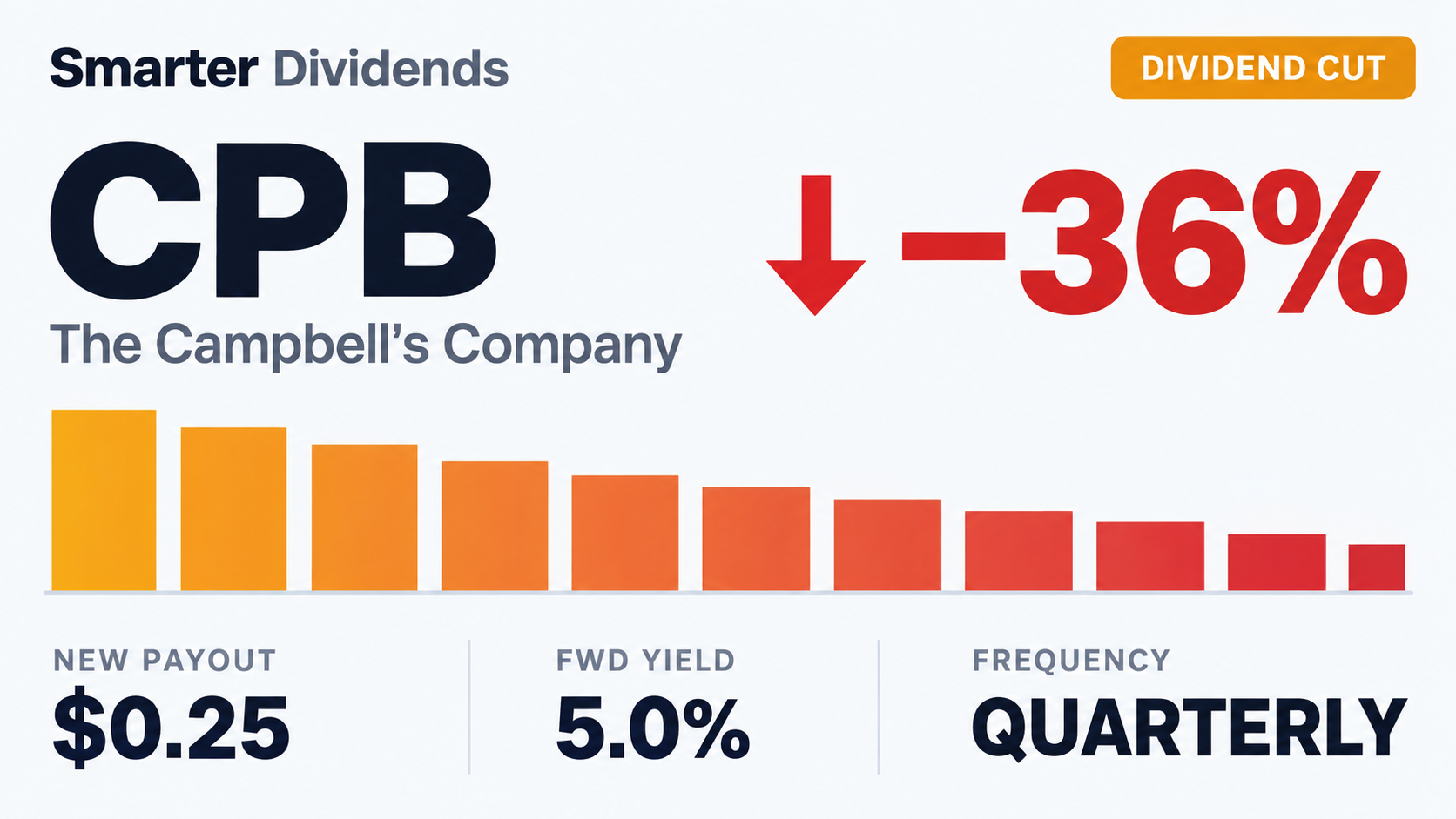
Campbell’s Cuts Quarterly Dividend 35.9% to $0.25
Campbell’s cuts its quarterly dividend 35.9% to $0.25, prioritizing debt reduction after weaker fiscal 2026 sales, earnings and cash generation.

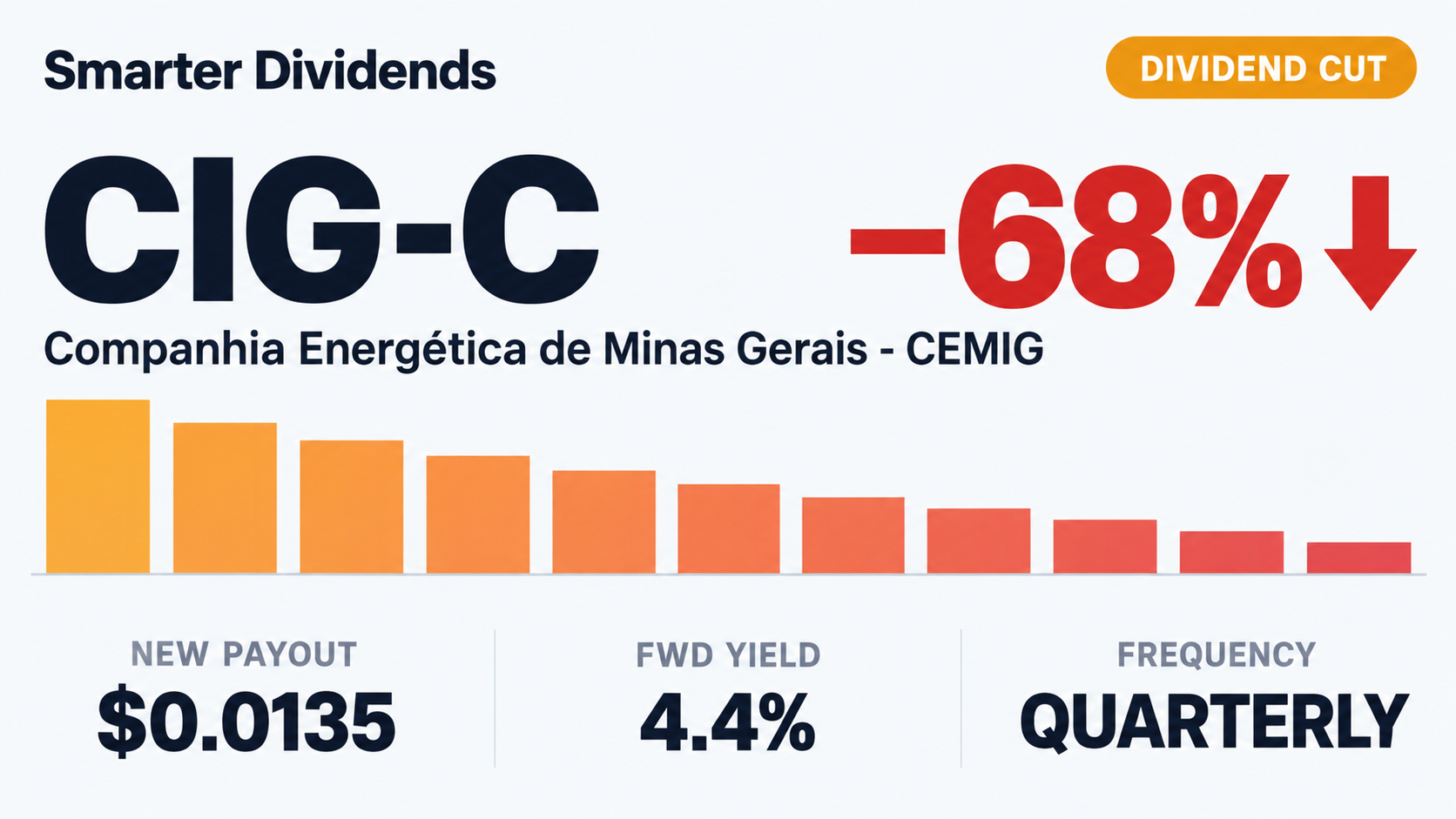
CEMIG Cuts CIG-C Dividend 68.4% to $0.0135
CEMIG’s CIG-C payout falls to $0.0135 a share, while a 79% earnings payout ratio and variable payment history frame the cut’s full significance.

Fidus Investment Cuts Quarterly Payout 19.35% to $0.50
Fidus Investment reduced its quarterly payout from $0.62 to $0.50, lowering the supplemental portion while leaving its base dividend intact.

TELUS (TU) Cuts Dividend 54.7% to $0.136, Ends 10-Year Streak
TELUS (TU) reset its quarterly dividend to $0.136 per share, a 54.7% cut aimed at reducing leverage after weaker results and lower 2026 guidance.

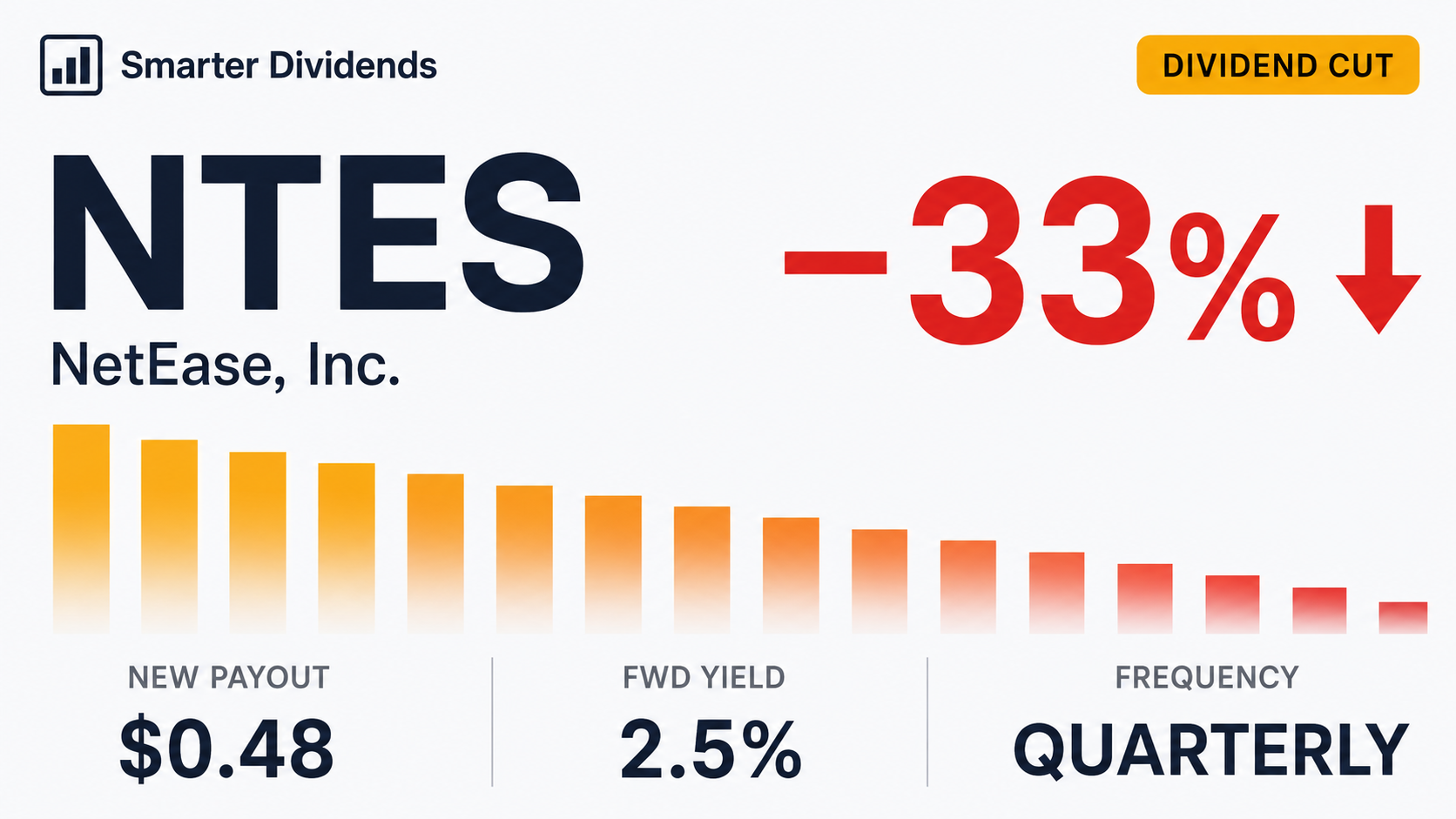
NetEase Cuts Quarterly Dividend 33.3% to $0.48
NetEase cut its quarterly dividend 33.3% to $0.48 as earnings and operating cash flow fell despite stronger revenue and gross profit in the second quarter.