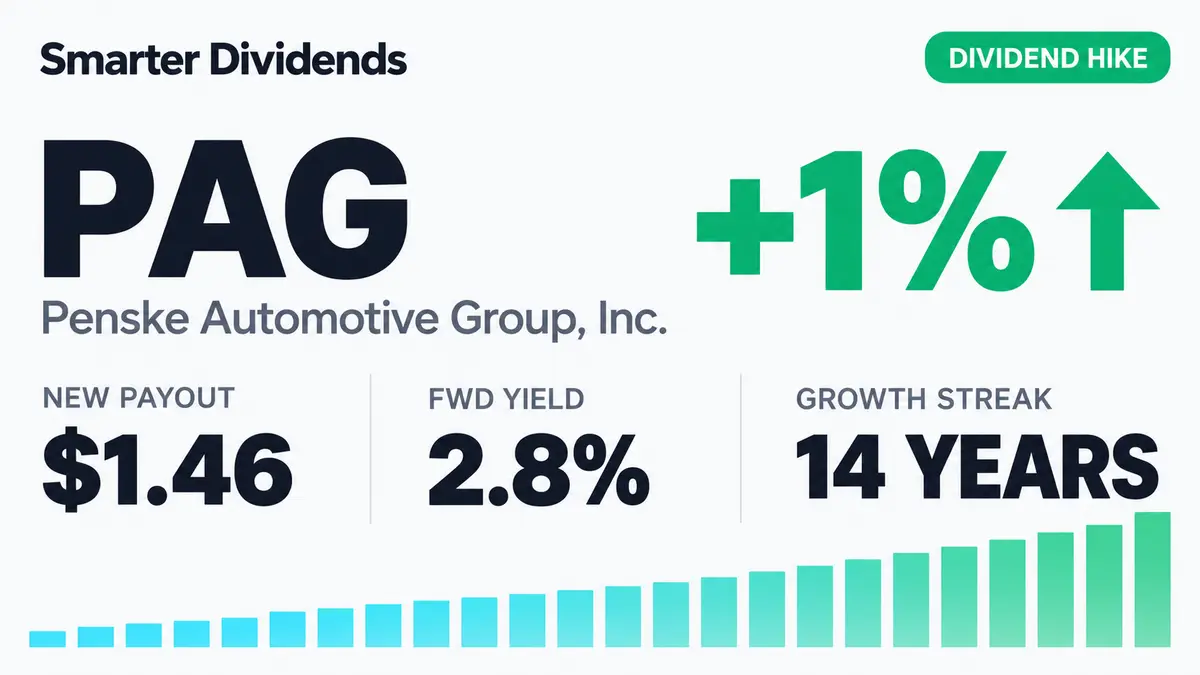
Penske Automotive Raises Dividend 1.4% to $1.46
Penske Automotive lifted its quarterly dividend to $1.46, extending its growth record as a planned take-private deal moves toward a shareholder vote.
 PAG — Penske Automotive Group, Inc.
Key takeaways
- Penske Automotive raised its quarterly dividend 1.4% to $1.46 a share.
- The annual dividend is $5.84, equal to $584.00 for every 100 shares.
- The 39% earnings payout ratio supports a B safety grade and a score of 69.
- The 2.75% forward yield is above the Consumer Cyclical sector median of 2.54%.
Penske Automotive Group increased its quarterly dividend 1.4% to $1.46 a share from $1.44. The shares are scheduled to trade ex-dividend on November 13, 2026, and the payment is due December 1, 2026. The new rate lifts the annual dividend to $5.84 a share. The company announced the declaration on October 15, 2026.
Why the dividend changed
Penske did not give a specific operating reason for the increase. Its announcement said only that the board had declared the higher quarterly payment. The decision nevertheless followed a period of revenue growth, continued cash generation and measured capital returns.
In its latest reported quarter, Penske said revenue increased 6% to $8.5 billion as deliveries of new and used vehicles rose. Net income attributable to common stockholders was $260.4 million, compared with $266.6 million a year earlier, while adjusted earnings per share were $3.62. Retail automotive same-store revenue increased 6%, and service and parts gross margin reached 59.5%. Chair Roger Penske also pointed to an improving freight environment and stronger orders for Class 8 trucks. Penske’s second-quarter results provide the operating and capital-allocation context.
Management said its balance sheet, cash generation and leverage supported a flexible approach to capital allocation. Penske repurchased $42.5 million of shares during the first six months of 2026 and reported about $1.4 billion of liquidity at June 30. It was also integrating two Lexus dealerships acquired in Florida after adding Toyota and Lexus operations in late 2025.
The dividend increase coincided with a special situation. On the same day as the declaration, Penske agreed to be taken private by Penske Corp. and Mitsui & Co. Under the merger agreement, the company may continue paying regular quarterly dividends before closing, subject to a limit tied to the preceding quarterly payment. The increase is consistent with that restriction. The deal is expected to close in the first quarter of 2027, subject to regulatory clearances and approval by shareholders, including unaffiliated holders. The merger announcement sets out the dividend provision and closing conditions.
Dividend track record
Penske has increased its dividend for 14 consecutive years. Its last annual cut occurred in 2011, giving the company a long record of rebuilding and then expanding the payout.
The recent pattern has been a sequence of small quarterly increases. The dividend was $1.19 for the November 15, 2024, ex-dividend date, followed by $1.22, $1.26, $1.32 and $1.38 during 2025. It then rose to $1.40, $1.42 and $1.44 in the first three payment cycles of 2026 before the new $1.46 rate.
Annual totals show how those incremental increases accumulated. Penske paid $4.09 a share in 2024 and $5.18 in 2025, an increase of 26.7%. That followed totals of $2.78 in 2023 and $2.07 in 2022. The record also shows only two payments totaling $0.84 in 2020, followed by four payments totaling $1.78 in 2021. The current pattern is therefore one of regular quarterly increases following an earlier interruption in the payment schedule.
Is the dividend covered?
The dividend consumes 39% of earnings. That payout ratio indicates that reported profit covers the distribution, with earnings also available for acquisitions, debt service, share repurchases and other corporate uses.
SmarterDividends rates the dividend B with a safety score of 69. That falls within the safe range of 66-79. The grade reflects solid earnings coverage and the established growth record, while stopping short of the highest safety tiers. The pending take-private transaction is now an additional consideration because the merger agreement governs distributions before closing and the public dividend would cease to be relevant after the shares are delisted.
Yield and valuation
Penske’s forward yield is 2.75%, compared with a 2.54% median for the Consumer Cyclical sector. At the annual rate of $5.84, an investor holding 100 shares would receive $584.00 a year before taxes, assuming the rate remains unchanged and all scheduled payments are made.
The shares recently traded at $212.09 and had produced a 31.3% gain over one year. SmarterDividends estimates fair value at $94.89 and classifies the shares as overvalued, with 55% downside to that estimate. That valuation assessment is separate from the terms of the announced take-private agreement, which has become the principal transaction-specific reference for the market price.
What to watch
The immediate dividend dates are November 13, 2026, for the next ex-dividend date and December 1, 2026, for payment. Investors also need to track the merger process because completion would end PAG’s public listing and change the relevance of future public-company dividends.
Penske scheduled its third-quarter results for October 28, 2026, without an earnings conference call because of the transaction. The release can provide updated evidence on automotive demand, service and parts margins, commercial-truck conditions, liquidity and capital allocation. Beyond earnings, the concrete milestones are regulatory approvals, publication of the transaction documents, the shareholder vote and the planned closing in the first quarter of 2027.
PAG dividend data
From the SmarterDividends dataset, updated daily
- Forward yield
- 2.75%
- Payout ratio
- 39%
- Growth streak
- 14 yrs
- Safety grade
- B · 69/100
| Ex-dividend date | Amount | Change |
|---|---|---|
| Aug 14, 2026 | $1.4400 | +1.4% |
| May 26, 2026 | $1.4200 | +1.4% |
| Feb 25, 2026 | $1.4000 | +1.4% |
| Nov 14, 2025 | $1.3800 | +4.5% |
| Aug 15, 2025 | $1.3200 | +4.8% |
| May 27, 2025 | $1.2600 | +3.3% |
| Feb 24, 2025 | $1.2200 | +2.5% |
| Nov 15, 2024 | $1.1900 | +11.2% |
Full PAG dividend history →·Next ex-dividend date (Nov 13, 2026) →
Frequently asked questions
When is the next PAG ex-dividend date?
Penske Automotive’s next ex-dividend date is November 13, 2026.
When will Penske Automotive pay its next dividend?
The next quarterly dividend is scheduled for payment on December 1, 2026.
How much is PAG’s new dividend per year?
The annual dividend is $5.84 a share. That represents annual income of $584.00 for every 100 shares, assuming the rate remains unchanged.
Is Penske Automotive’s dividend safe?
SmarterDividends rates the dividend B with a safety score of 69, within the safe range of 66-79. Its earnings payout ratio is 39%.
What is PAG’s dividend yield?
Penske Automotive’s forward yield is 2.75%, compared with a 2.54% median for the Consumer Cyclical sector.
Sources
See PAG's full dividend profile
Yield, payout, safety score, history and the next ex-dividend date.
View PAGEvery dividend increases this month, with the data behind it: Dividend Increases, October 2026.
More dividend news
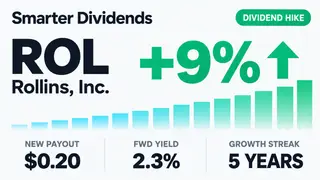
Rollins Raises Quarterly Dividend 9.3% to $0.20
Rollins lifts its quarterly dividend 9.3% to $0.20, with a 2.32% forward yield, as cash flow improves but earnings coverage remains moderate.

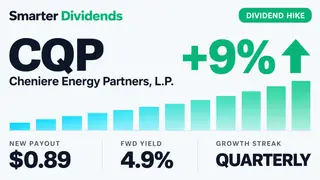
Cheniere Partners Raises Quarterly Distribution 8.5% to $0.89
CQP’s quarterly payout rises 8.5% to $0.89 per unit as stronger LNG margins support a larger variable distribution and a 4.93% forward yield.

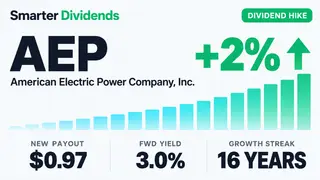
American Electric Power Raises Dividend 2.1% to $0.97
AEP lifted its quarterly dividend 2.1% to $0.97, extending a 16-year growth streak as the utility advances a $78 billion capital plan.
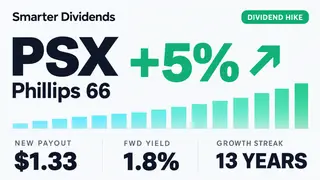
Phillips 66 Raises Quarterly Dividend 4.7% to $1.33
Phillips 66 lifted its quarterly dividend to $1.33, extending a 13-year growth run as earnings coverage remains strong despite a yield below the Energy median.
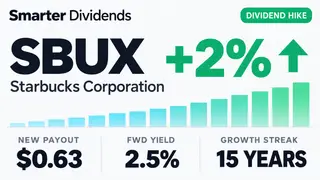
Starbucks Raises Quarterly Dividend 1.6% to $0.63
Starbucks lifted its quarterly dividend 1.6% to $0.63, extending its annual growth record while an earnings payout ratio of 143% tests coverage.