High-Yield Funds: Did Anyone Actually Make Money? We Checked
November 10, 2026 · 10:47 · 0 views · data through November 6, 2026
We sent a made-up investor back in time with $10,000 for each of seven high-yield funds (JEPQ, MSTY, ULTY, PDI, GOF, NLY and ARR), took every payment as cash, and counted what he had on November 6, 2026, against a plain S&P 500 fund bought the same day. Six made money. One beat the index.
The numbers in this video
- ARR: $10,000 at the end of 2009, 192 payments later
- $10,106 ($106 profit)
- Same $10,000 in an S&P 500 fund (SPY)
- $73,491
- MSTY: cash plus shares, Feb 2024 to Nov 6, 2026
- $23,681
- ULTY after 100 payments
- $9,853 (down $147)
- JEPQ: cash plus shares, May 2022 to Nov 6, 2026
- $15,665
- Made money / beat the S&P 500 fund
- 6 of 7 / 1 of 7
$1,000,000 invested at the last month-end close before the start year, split-adjusted. Regular dividends only, spent as they arrive. No taxes or trading costs; each fund's own expense ratio is already in its prices. Past results from one period, not a forecast. Education only, not investment advice.
Run it with your own numbers
ARR total return →
Kevin's $106 profit, and the same page for any fund: cash collected plus what the shares are worth.
Option-income ETFs compared →
JEPQ, MSTY, ULTY and the rest: yield, price change and total return side by side.
JEPQ vs SCHD →
Kevin's paycheck fund against Ruth's dividend-growth fund.
MSTY total return →
The one fund that beat the S&P 500, and how much of it was the price falling.
Full transcript
0:00192 payments, $106 profit
At the end of 2009, you could have put $10,000 into a fund that paid you almost every single month. It paid you 192 times.
Almost seventeen years later, after every one of those payments, your total profit is $106.
The same $10,000 in a plain S&P 500 fund would be $73,491 today.
High-yield funds are everywhere right now. Ten percent. Twenty percent. One of them paid out more than its own share price in the last twelve months. On our website, these are some of the funds people look up the most.
So we asked the only question that matters. Did the people who bought them actually make any money?
And we sent Kevin to find out.
0:55Kevin wants a paycheck
You might remember Kevin. In 2022, he panicked, sold everything, and bought SCHD. Now he's bored of it. Three percent? Kevin wants a real paycheck.
Kevin is made up. His money isn't. Every price and every payment in this video really happened.
Here's the game. For each fund, Kevin goes back in time with $10,000. He buys on the day the fund started trading, or at the end of 2007 for the older ones.
Every payment it sends him, he takes as cash. That's the whole point of a high-yield fund. It's a paycheck.
At the end, we count two piles: the cash he collected, and what his shares are worth today, on November 6th, 2026. Add them up. If it's more than $10,000, Kevin made money.
And to keep score, the same $10,000 goes into a plain S&P 500 fund on the same day, with its dividends taken as cash too.
Seven funds. Let's go.
2:07The new kids: JEPQ, MSTY, ULTY
First stop, May 2022. JEPQ, from JPMorgan. It owns big tech stocks and sells options on the Nasdaq 100, which turns some of the upside into monthly income. Today it yields about 12 percent.
Kevin collects $5,030 in cash. His shares are worth $10,635. Total, $15,665. The S&P 500 fund has $17,872. So JEPQ made real money. A little less than the index, but real money. Honestly, not bad.
Next, February 2024. MSTY, from a company called YieldMax. It sells options on just one stock, Strategy, the company that buys bitcoin. Over the last twelve months, MSTY paid out 141 percent of its share price. That is not a typo.
Kevin's $10,000 sends him $22,484 in cash, in less than three years. His shares, though, are worth $1,197. The price fell 88 percent.
Add it up: $23,681. The S&P 500 fund has $14,881. Kevin beat the market, by a lot. Kevin is thrilled. Kevin is buying more.
So Kevin goes back one week later and buys MSTY's sibling, ULTY. Same company, same idea, but spread across a basket of jumpy stocks instead of one.
ULTY pays him $8,790. His shares are worth $1,063. Total, $9,853. After 100 payments, Kevin is down $147.
Same company. Same month. One more than doubled his money. The other spent almost three years handing his own money back to him, a little at a time. The difference wasn't the yield. MSTY rode a bitcoin boom, and ULTY didn't have one. A yield that big isn't a paycheck. It's a bet wearing a paycheck costume.
4:40The old pros: PDI, GOF
Maybe the new funds are just too wild. So Kevin tries the old pros, bond funds that have paid every month for years.
May 2012. PDI, from PIMCO. Bonds, mortgages, loans, and some borrowed money on top. Kevin collects $18,557 in cash. That's almost twice what he put in. But his shares are now worth $5,928. The price fell 41 percent.
Total, $24,485. The S&P 500 fund has $61,584.
The end of 2007. GOF, from Guggenheim. Since 2014, it has paid Kevin exactly $1,233 a year. Every year. Like clockwork.
That adds up to $22,258 in cash. His shares are worth $5,079, about half what he paid. Total, $27,337. The S&P 500 fund has $56,349.
And here's the quiet part. That paycheck never got a raise. $1,233 bought a lot more in 2014 than it does today.
6:10The mortgage machines: NLY, ARR
Last stop, the biggest paychecks on the old-school side: mortgage REITs. They borrow money cheaply, buy mortgage bonds, and pay out the difference.
Annaly, NLY. Kevin buys at the end of 2007. In 2010, his $10,000 pays him $1,458. Then the paycheck starts to shrink. And shrink. Last year, it paid him $385.
His shares are worth $2,578. Total, after almost nineteen years, $16,621. The S&P 500 fund has $56,349.
And then there's ARMOUR, ARR, the fund from the start of this video. End of 2009. In its first year, it pays Kevin $1,842. Last year, $87.
The price fell 96 percent. Kevin's $10,000 of shares is worth $382 today. 192 payments, $9,725 in cash. Total, $10,106. Almost seventeen years. $106.
And if Kevin had done the responsible thing and reinvested every payment? He'd have $4,813. Reinvesting made it worse, because every payment bought more shares of something that kept falling.
7:50The scoreboard
Seven funds. Let's count.
Made money? Six out of seven. Beat a plain S&P 500 fund? One: MSTY, riding a bitcoin boom.
So if a 20 percent yield isn't coming from big profits, where is it coming from? Mostly three places.
Selling options. You trade away the big upside for cash today. When the stock rockets, you don't get all of it. When it crashes, you get all of that.
Borrowed money. Bond funds and mortgage REITs borrow to boost what they pay. Great while it works. Painful when rates jump.
And sometimes, your own money. A fund can pay out more than it earns, and the difference comes out of the share price. That's called NAV erosion. The paycheck stays big. The pile underneath it shrinks.
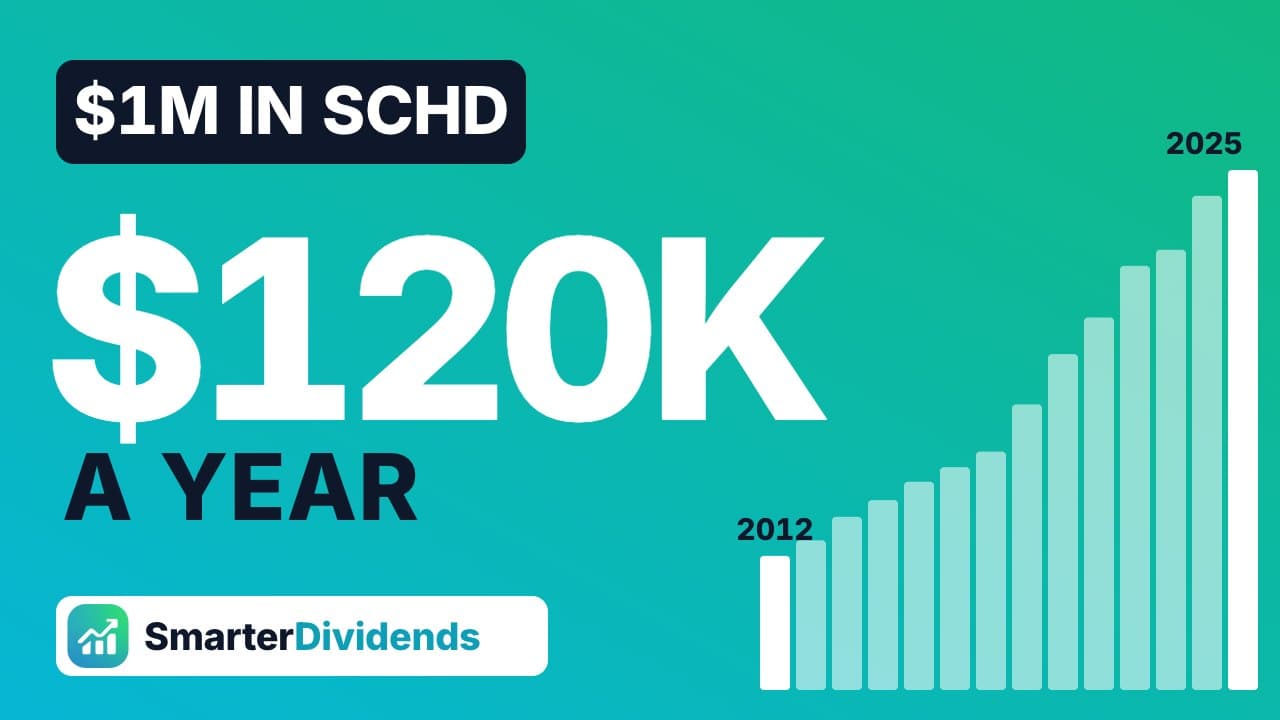
Remember Ruth? Her SCHD yields about 3 percent. Boring. But watch her paycheck. Her $10,000 paid her $324 in 2012. Last year, it paid her $1,257, almost four times as much. Her shares grew 322 percent, so her paycheck grew with them.
In 2012, ARMOUR paid Kevin more than four times what SCHD paid Ruth. By 2016, Ruth had passed him, and she never looked back.
9:23So should you buy them?
So are high-yield funds a scam? No. JEPQ made real money. PDI and GOF paid real cash for years, and some people need exactly that, a steady check, and don't mind what the share price does.
But the yield is not the return. Before you buy one, ask three questions.
One. What has the share price done since it started? If it keeps sliding, part of your paycheck is your own money coming back.
Two. Add the cash to the shares, and compare it with a plain index fund over the same years. That's the real score.
Three. Where does the cash come from? Options, borrowed money, or one hot stock? Know what you're actually betting on.
You can check all of this for any fund on smarterdividends.com. Type in the ticker, and look at the total return, not just the yield.
As for Kevin, he says he's done chasing yield. He's going back to SCHD. Right after one more week of MSTY.