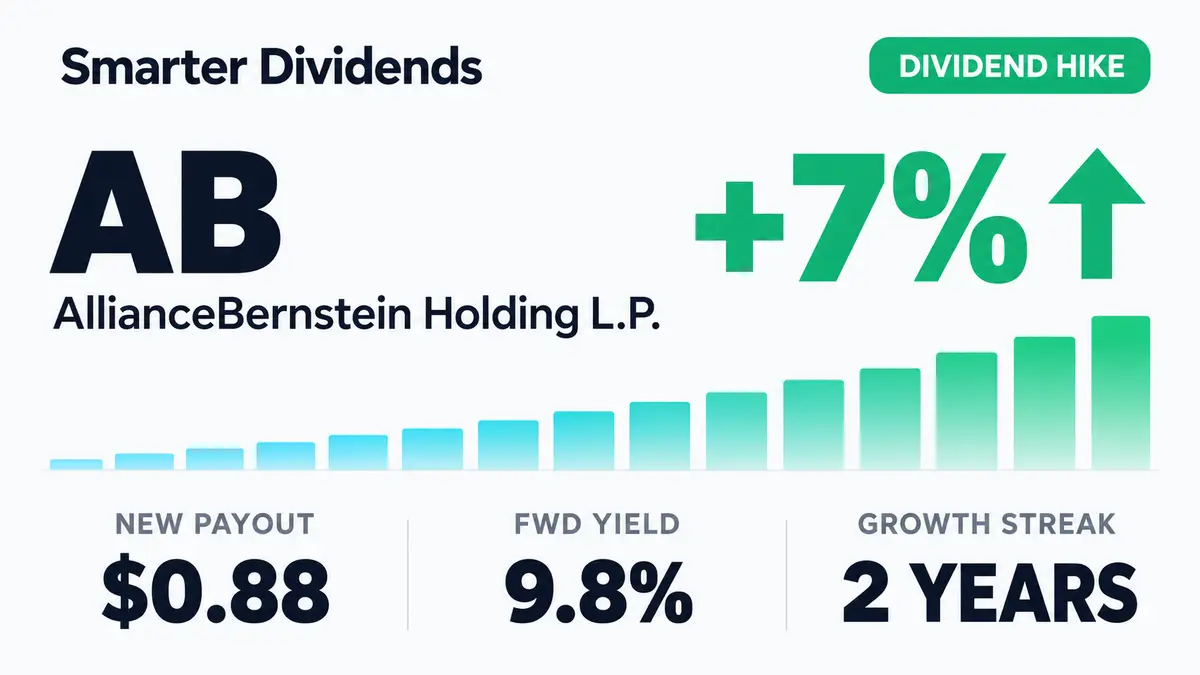
AllianceBernstein Raises Quarterly Distribution 7.3% to $0.88
AllianceBernstein’s new $0.88 quarterly distribution lifts its forward yield to 9.84%, while earnings coverage remains tight at a 101% payout ratio.
 AB — AllianceBernstein Holding L.P.
Key takeaways
- AllianceBernstein raised its quarterly cash distribution 7.3% to $0.88 from $0.82.
- The next ex-dividend date is November 6, 2026, followed by payment on November 19, 2026.
- The 9.84% forward yield is above the Financial Services sector median of 5.84%.
- The 101% earnings payout ratio accompanies a safety score of 55 and a grade of C.
AllianceBernstein Holding L.P. raised its quarterly cash distribution 7.3%, taking the rate to $0.88 per unit from $0.82. AB units trade ex-dividend on November 6, 2026, and the distribution is payable on November 19, 2026.
Why the dividend changed
AllianceBernstein’s payout moves with earnings by design. AB Holding is a publicly traded partnership, not a conventional corporation, and its annual report says it must distribute all available cash flow to unitholders. Available cash flow typically tracks adjusted net income per unit, though management and the board can approve adjustments. The third-quarter distribution matched adjusted earnings per unit, so the higher payment reflects the quarter’s improved adjusted earnings rather than a commitment to a fixed rate. AllianceBernstein’s 2025 annual report explains the policy, while the third-quarter results connect the latest payment to earnings.
The operating picture was mixed but supportive. Third-quarter adjusted net revenue rose 2.2% from a year earlier as higher base and performance fees offset weaker investment gains and lower net dividend and interest revenue. Adjusted operating income was essentially flat from a year earlier but increased 3.3% sequentially. That combination lifted adjusted earnings per unit from the second quarter and, under AB’s distribution formula, lifted the cash payment with it. The company’s results release provides the financial comparisons.
Flows also show where the business is gaining and losing ground. AB reported $6.6 billion of firmwide net inflows, its strongest quarter in four years. Alternatives and multi-asset solutions brought in $15 billion, including roughly $12 billion of commercial mortgage loans transferred from Equitable, and private-markets assets reached $105 billion. Against that, retail recorded more than $8 billion of net outflows as active-equity redemptions and rate-sensitive taxable fixed-income withdrawals persisted. Management’s third-quarter commentary identifies insurance, private markets, separately managed accounts and exchange-traded funds as its principal growth areas.
Dividend track record
The latest increase does not create a conventional steadily rising dividend. Quarterly payments have moved with AB’s earnings: $0.96 went ex-dividend on February 20, 2026, followed by $0.83 on May 8 and $0.82 on August 12 before the new $0.88 rate. The sequence shows why one quarter’s increase should be read as a change in distributable earnings, not as a permanent base.
Full-year totals have nevertheless recovered for two consecutive years. The annual distribution fell 26.0% to $2.62 in 2023, the last annual cut, then rose 13.7% to $2.98 in 2024 and 16.4% to $3.47 in 2025. The current growth streak is 2 years. The longer record remains uneven: 2022’s $3.54 total was down 1.1% from $3.58 in 2021, after the 2021 total had risen 28.3% from $2.79 in 2020.
AB’s partnership status also matters to the record. The company describes these payments as cash distributions rather than corporate dividends, and unitholders generally receive a Schedule K-1. AB says the distributions affect tax basis rather than being reported as dividend income, making the tax treatment different from a standard common stock. AllianceBernstein’s tax information page outlines that structure.
Is the dividend covered?
The earnings payout ratio is 101%, meaning the distribution slightly exceeds the earnings captured by that measure and leaves little conventional coverage cushion. That is a more strained reading than the third-quarter adjusted result alone, where adjusted earnings per unit matched the cash distribution under AB’s available-cash-flow approach.
SmarterDividends gives the distribution a safety score of 55 and a grade of C. The grade means borderline, within the 50-65 range: current payments remain supported, but the margin for weaker earnings is limited. AB’s variable payout structure can transmit changes in asset-management revenue and adjusted earnings directly into the quarterly distribution, as the payment history shows.
Yield and valuation
At a share price of $35.29, AB’s annual dividend per share is $3.47 and its forward yield is 9.84%. That is above the Financial Services sector median forward yield of 5.84%. The units posted a 15.4% loss over the past year, which helps explain why the current yield is elevated. For 100 units, the stated annual income is $347.00.
SmarterDividends estimates fair value at $54.74 and classifies the units as undervalued, with 57% upside to fair value. The estimate is a valuation benchmark, not a forecast, and it sits alongside a market value of $3.3 billion.
What to watch
The immediate dates are November 6, 2026, when AB trades ex-dividend, and November 19, 2026, when the payment is due. Beyond those dates, the next quarterly earnings release is the key distribution event because AB typically declares its cash distribution with results and bases available cash flow on adjusted earnings per unit. AB’s investor FAQ describes that timetable.
Operating items to monitor are the conversion of AB’s institutional pipeline into funded assets, further insurance-related asset onboarding and the pressure in active equities. Management said the institutional pipeline was about $13 billion at quarter-end and excluded the planned $100 billion associated with CRBG, while active-equity outflows remained a drag. Those items affect fees and adjusted earnings, the inputs that ultimately shape the variable quarterly distribution. The third-quarter release provides the latest pipeline and flow detail.
AB dividend data
From the SmarterDividends dataset, updated daily
- Forward yield
- 9.84%
- Payout ratio
- 101%
- Growth streak
- 2 yrs
- Safety grade
- C · 55/100
| Ex-dividend date | Amount | Change |
|---|---|---|
| Aug 12, 2026 | $0.8200 | -1.2% |
| May 8, 2026 | $0.8300 | -13.5% |
| Feb 20, 2026 | $0.9600 | +11.6% |
| Nov 3, 2025 | $0.8600 | +13.2% |
| Aug 4, 2025 | $0.7600 | -5.0% |
| May 5, 2025 | $0.8000 | +3.9% |
| Feb 18, 2025 | $1.0500 | special |
| Nov 4, 2024 | $0.7700 | +8.5% |
Full AB dividend history →·Next ex-dividend date (Nov 6, 2026) →
Frequently asked questions
When is the next AB ex-dividend date?
The next AllianceBernstein ex-dividend date is November 6, 2026.
When will AllianceBernstein pay the new distribution?
The $0.88 distribution is payable on November 19, 2026.
How much is AllianceBernstein’s new quarterly distribution?
AllianceBernstein’s new quarterly rate is $0.88 per unit, up 7.3% from $0.82.
How much does AB pay annually?
AB’s annual dividend per share is $3.47. The stated annual income for 100 shares is $347.00.
Is AB’s dividend safe?
The earnings payout ratio is 101%. SmarterDividends assigns a safety score of 55 and a grade of C, meaning borderline within the 50-65 range.
Sources
See AB's full dividend profile
Yield, payout, safety score, history and the next ex-dividend date.
View ABEvery dividend increases this month, with the data behind it: Dividend Increases, October 2026.
More dividend news

NW Natural Raises Dividend 1.4% to $0.50, Extends 71-Year Streak
NW Natural raised its quarterly dividend 1.4% to $0.50, with the next payment due November 13, 2026, as earnings and utility investment rise.

IDACORP Raises Quarterly Dividend 2.3% to $0.90
IDACORP raises its quarterly dividend 2.3% to $0.90 as customer growth supports earnings and heavy infrastructure spending tempers payout growth.
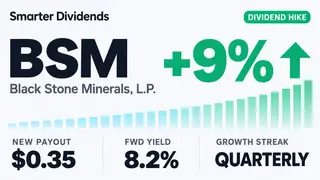
Black Stone Minerals Raises Quarterly Distribution 9.4% to $0.35
Black Stone Minerals lifted its quarterly distribution 9.4% to $0.35, with an 8.19% forward yield and a November 13, 2026 payment date for unitholders.

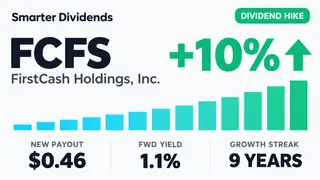
FirstCash Raises Quarterly Dividend 9.5% to $0.46
FirstCash lifted its quarterly dividend 9.5% to $0.46, backed by a 19% earnings payout ratio and a nine-year growth streak, while its yield trails the sector.

Bread Financial Raises Dividend 8.7% to $0.25
Bread Financial lifted its quarterly payout to $0.25 as stronger earnings, improving credit metrics and disciplined capital management supported the move.