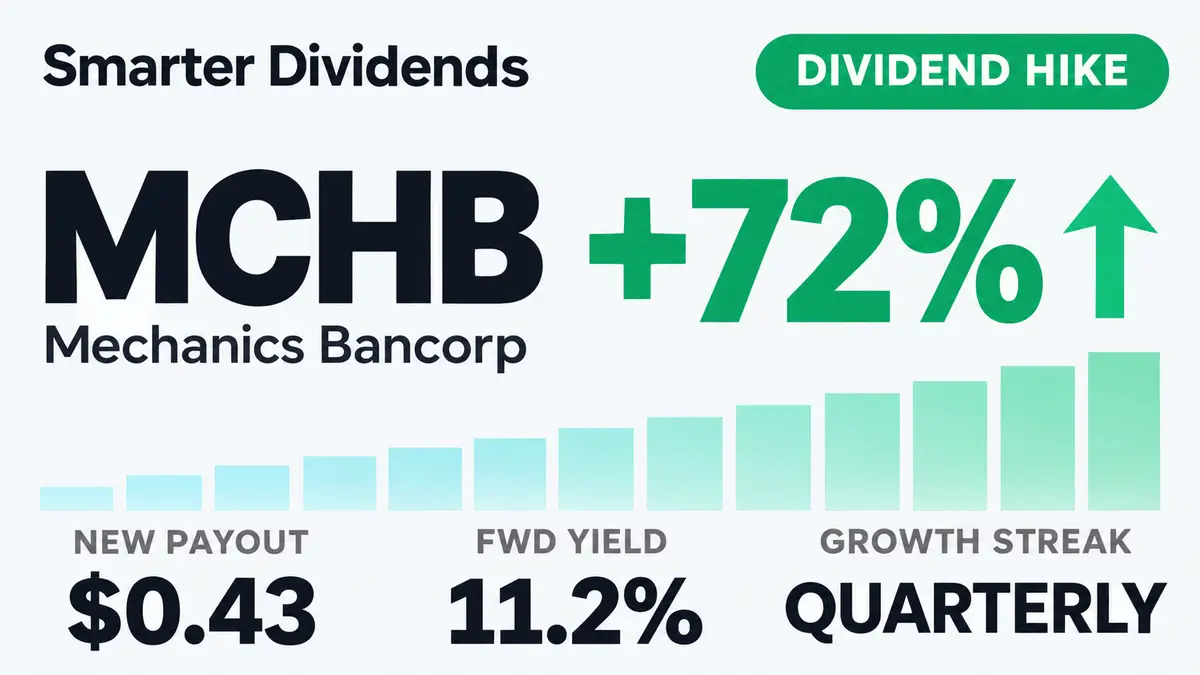
Mechanics Bancorp Raises Quarterly Dividend 72.0% to $0.43
Mechanics Bancorp lifted its quarterly dividend 72.0% to $0.43, while a 133% earnings payout ratio keeps the distribution's coverage in focus.
 MCHB · Mechanics Bancorp
Key takeaways
- The quarterly dividend increased 72.0% to $0.43 from $0.25.
- The forward yield is 11.22%, compared with a 5.94% Financial Services sector median.
- The earnings payout ratio is 133%, while the dividend carries a safety score of 42 and a D grade.
- The next $0.43 payment is scheduled for December 10, 2026, following the November 30, 2026, ex-dividend date.
Mechanics Bancorp raised its quarterly dividend 72.0% to $0.43 per share from $0.25. MCHB shares trade ex-dividend on November 30, 2026, and the payment is due December 10, 2026.
Why the dividend changed
The declaration supplied no detailed rationale for the increase, saying only that the board approved the Class A distribution. The latest results, however, show that management has made capital returns a central part of its post-merger strategy. Chief Executive C.J. Johnson said the bank was focused on prudent growth, expense control, credit quality and returning capital through what he called a “market-leading dividend yield.” Mechanics Bancorp’s dividend release confirms the payment terms, while its third-quarter results provide the strategic context.
Mechanics reported third-quarter net income of $46.0 million, down from $57.7 million in the second quarter. Results included losses from a securities restructuring and the sale of performing indirect auto loans. The bank said it reinvested proceeds from lower-yielding securities at higher market rates and accelerated its exit from a non-core auto-lending business. Management said these actions were intended to improve the earnings profile and reduce future servicing costs. The bank also reported lower acquisition and integration expenses after combining with HomeStreet Bank. The quarterly release details those changes.
The dividend pattern also reflects special capital-management actions. Before the $0.70 payment with a May 22, 2026, ex-dividend date, management said a smaller balance sheet and the planned sale of its Fannie Mae multifamily servicing business were expected to produce excess capital for a larger second-quarter distribution. That makes the May payment better understood as a discrete capital return than as a recurring quarterly baseline. Mechanics Bancorp’s investor presentation outlined that plan.
The broader special situation is the HomeStreet transaction. HomeStreet Bank merged into Mechanics Bank on September 2, 2025, and the combination was accounted for as a reverse acquisition. Historical share figures were restated using the merger exchange ratio, limiting the usefulness of simple pre-merger dividend comparisons. Mechanics Bancorp’s annual filing explains the accounting treatment.
Dividend track record
Mechanics does not have an uninterrupted growth record. The annual total increased 66.7% to $1.00 in 2021 and rose another 40.0% to $1.40 in 2022. It then fell 53.6% to $0.65 in 2023, the last annual cut year. The consecutive growth count is 0 years.
For 2025, the record contains one payment totaling $0.21. Payments then became uneven in 2026: $0.40 with a March 9 ex-dividend date, $0.70 with a May 22 date, $0.25 with an August 28 date and the newly declared $0.43. This sequence reflects the merger transition and episodic capital returns more than a steadily compounding quarterly dividend. The stated annual dividend per share is $1.56, equal to $156.00 of annual income per 100 shares.
Is the dividend covered?
The earnings payout ratio is 133%. A ratio above earnings means the stated dividend exceeds the earnings measure used for the calculation, leaving less room for weaker results or additional balance-sheet charges. No free-cash-flow payout ratio is included because cash-flow analysis for banks is less directly comparable with that used for industrial companies.
SmarterDividends rates the dividend D, with a safety score of 42. That falls in the unsafe (36-49) range. In plain terms, the grade reflects thin earnings coverage and an inconsistent payment history even though management reports strong regulatory capital and has prioritized shareholder distributions.
Yield and valuation
At a share price of $14.30, MCHB’s forward yield is 11.22%, compared with a 5.94% median for the Financial Services sector. The gap makes the income rate unusually high relative to the sector, but it also corresponds with the 133% earnings payout ratio and D safety grade.
The shares have recorded a 4.9% loss over one year, and Mechanics has a market value of $3.2 billion. The combination of a lower share price and a larger distribution supports the elevated forward yield. It does not, by itself, establish that the payment is sustainably covered.
What to watch
The immediate dates are November 30, 2026, when the shares trade ex-dividend, and December 10, 2026, when the $0.43 payment is scheduled. Subsequent earnings reports will show whether coverage improves after the securities restructuring, auto-loan exit and decline in merger-related costs.
Investors can also track deposit costs, credit quality, loan balances and regulatory capital. Mechanics said third-quarter deposits were broadly stable, delinquent loans declined and the HomeStreet integration was substantially complete. Its annual filing notes that dividends from the banking subsidiary remain subject to capital requirements and restrictions intended to keep the bank well capitalized. Those measures will help determine the financial flexibility available for future quarterly declarations.
MCHB dividend data
From the SmarterDividends dataset, updated daily
- Forward yield
- 11.22%
- Payout Ratio
- 133%
- Growth streak
- 0 yrs
- Safety grade
- D · 42/100
| Ex-dividend date | Amount | Change |
|---|---|---|
| Aug 28, 2026 | $0.2500 | -37.5% |
| May 22, 2026 | $0.7000 | special |
| Mar 9, 2026 | $0.4000 | +90.5% |
| Dec 8, 2025 | $0.2100 | — |
| Nov 7, 2023 | $0.1000 | +0.0% |
| Aug 8, 2023 | $0.1000 | +0.0% |
| May 9, 2023 | $0.1000 | -71.4% |
| Feb 7, 2023 | $0.3500 | +0.0% |
Full MCHB dividend history →·Next ex-dividend date (Nov 30, 2026) →
Frequently asked questions
When is MCHB’s next ex-dividend date?
The next MCHB ex-dividend date is November 30, 2026.
When will Mechanics Bancorp pay its next dividend?
The $0.43 quarterly dividend is scheduled to be paid on December 10, 2026.
How much is the new MCHB dividend?
The new quarterly rate is $0.43 per share, up 72.0% from $0.25. The stated annual dividend is $1.56 per share.
What is MCHB’s dividend yield?
MCHB’s forward yield is 11.22% at a $14.30 share price. The Financial Services sector median is 5.94%.
Is Mechanics Bancorp’s dividend safe?
SmarterDividends assigns the dividend a safety score of 42 and a D grade, meaning unsafe (36-49). The earnings payout ratio is 133%, indicating thin coverage.
Sources
See MCHB's full dividend profile
Yield, payout, safety score, history and the next ex-dividend date.
View MCHBEvery dividend increases this month, with the data behind it: Dividend Increases, November 2026.
More dividend news

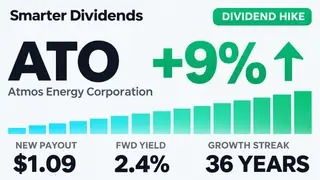
Atmos Energy Raises Quarterly Dividend 9.0% to $1.09
Atmos Energy lifted its quarterly dividend 9.0% to $1.09, extending a 36-year growth run while preparing for higher fiscal 2027 capital spending.

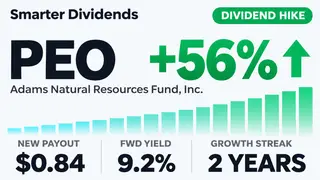
Adams Natural Resources Fund Raises Dividend 55.6% to $0.84
Adams Natural Resources Fund raised its quarterly distribution 55.6% to $0.84, lifting the forward yield to 9.15% with payment due December 4, 2026.

Global Ship Lease Raises Quarterly Dividend 10.1% to $0.688
Global Ship Lease lifts its quarterly payout 10.1% to $0.688, backed by charter coverage, while its safety grade remains borderline amid fleet renewal.

Adams Diversified Equity Fund Raises Dividend 12.0% to $0.56
ADX's quarterly payout rises 12.0% to $0.56, with a 9.34% forward yield, while capital gains and its managed policy shape coverage for shareholders.

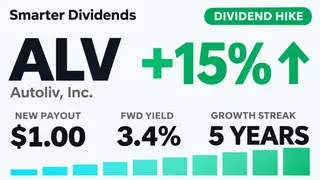
Autoliv Raises Quarterly Dividend 14.9% to $1.00
Autoliv lifted its quarterly dividend 14.9% to $1.00, backed by cash-flow guidance and a five-year run of higher annual payments in a difficult auto market.