What Happens to Your Dividends in a Stock Market Crash? We Checked
November 12, 2026 · 10:19 · 0 views · data through November 11, 2026
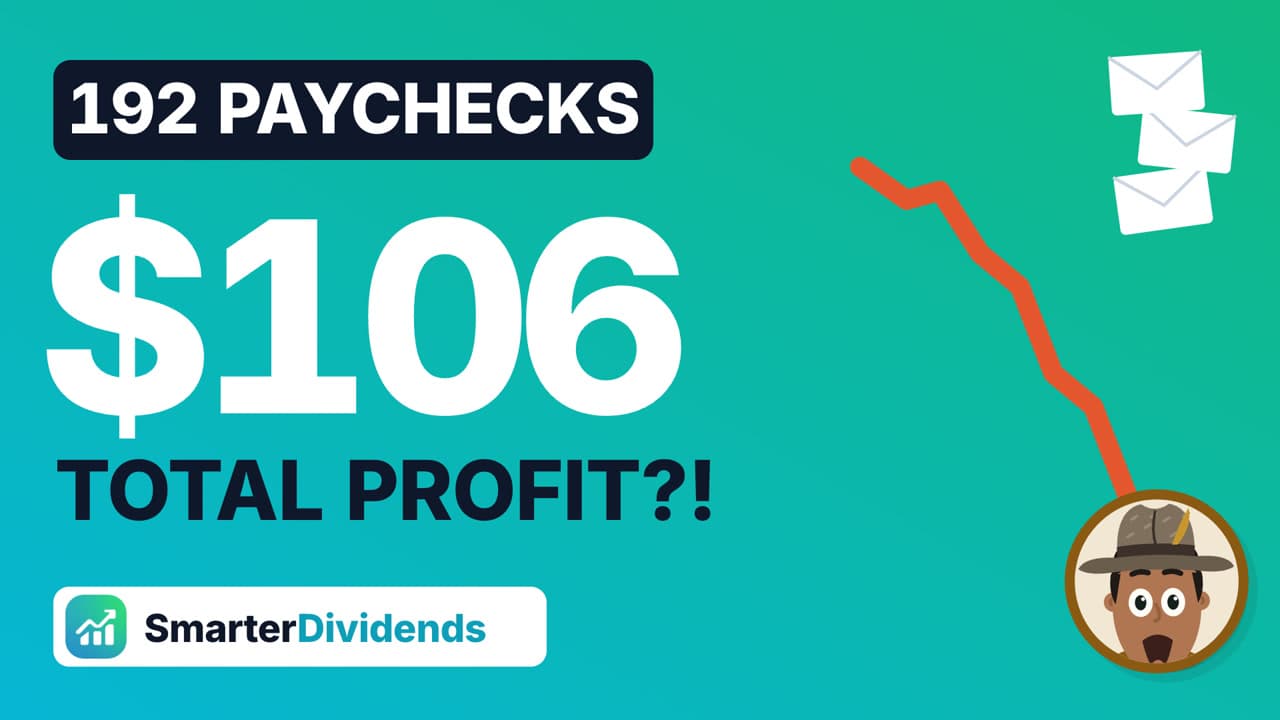
We sent two made-up retirees back to October 9, 2007, the stock market's record close before the crash, gave each $1,000,000 in five dividend stocks, and opened their mail through 2008, 2020 and every year up to November 11, 2026, next to an S&P 500 fund. Kevin's five stocks paying over 4% cut his paycheck 86%. Ruth's five paying about 2% paid her more every single year.
The numbers in this video
- S&P 500 fund (SPY), Oct 9, 2007 to Mar 9, 2009
- -56.5%
- Kevin's paycheck in 2010 (started at $44,415)
- $6,256 (down 86%)
- Ruth's paycheck in 2025 (started at $20,254)
- $81,726
- S&P 500 fund's paycheck in 2009 (2008: $17,389)
- $13,912 (down 20%)
- Dividend Raise Index, March 2009 (normally about 89)
- 40
- Kevin's $1,000,000 on Nov 11, 2026, never sold
- $925,879
$1,000,000 per retiree invested at the October 9, 2007 close, $200,000 in each of five stocks; the S&P 500 fund (SPY) got $1,000,000 the same day. Split-adjusted daily closes. A year's paycheck is every dividend with an ex-date in that year, taken as cash; shares are never sold. No taxes or trading costs. Past results from one period, not a forecast. Education only, not investment advice.
Run it with your own numbers
Dividend Raise Index →
Our monthly count of dividend raises against cuts since 2000. It hit 40 in March 2009 and 31.6 in June 2020.
Bank of America dividend history →
Every payment, including the cut from 64 cents a quarter to one cent in 2008 and 2009.
Coca-Cola dividend history →
One of Ruth's five, raise by raise.
SPY dividend history →
The S&P 500 fund's dividends by year: about a fifth lower in 2009, and no drop at all in 2020.
Full transcript
0:00Stocks -56%. The paycheck?
On October 9th, 2007, the American stock market closed at a record high. Seventeen months later, it had lost more than half its value.
Now imagine you had just retired. You're not selling anything. You're living on the dividends. So the only question you care about is this. What happened to the paycheck?
For the S&P 500 as a whole, it fell by about a fifth. Painful. But you'd live.
For one retiree in this video, it fell 86 percent. For another, it went up. Every single year.
Same crash. Same day. Three very different paychecks.
With so much talk about an AI bubble and the next crash, we went back and checked what really happens to your dividends when the market falls apart.
0:54The worst day to retire
Meet Kevin and Ruth. They're made up. Their money isn't. Every price and every payment in this video really happened.
We sent them both back to the worst possible day to retire. October 9th, 2007. The very top. Each of them gets one million dollars. The rules are simple. They live on the dividends, and they never sell a share.
Kevin wants the biggest paycheck he can get. So he picks five famous companies that all paid over 4 percent. Bank of America. Citigroup. Pfizer. KeyCorp. And Fifth Third. These weren't fly-by-night names. Pfizer had raised its dividend every year for over thirty years. Kevin's paycheck is $44,415 a year.
Ruth picks five boring companies that had paid dividends for decades. Coca-Cola. Johnson and Johnson. Procter and Gamble. PepsiCo. And McDonald's. They pay about 2 percent. Her paycheck is $20,254. Less than half of Kevin's. Kevin thinks this is very funny.
And to keep score, a plain S&P 500 fund. Same day, same rules. It pays $17,376.
One honest note before we start. We picked these ten companies knowing how the story ends. So this is not a list of stocks to buy. It's a look at what a crash can do to a paycheck. And for the market as a whole, we'll use the real numbers for every company.
2:442008: the paycheck test
Then the floor gives way. Banks start to fail. By March 9th, 2009, the stock market is down 56.5 percent from that October record.
On paper, everyone is crushed. Ruth's million is worth $706,398. The S&P fund, $435,263. Kevin's million is worth $161,560.
But remember, nobody is selling. They live on the paycheck. So let's open the mail.
Bank of America had been paying 64 cents a share every quarter. In December 2008, it cut that in half. Three months later, it cut it to one cent. Kevin's checks from Bank of America went from $8,522 a year to $152.
Citigroup paid him $42 in all of 2009, and nothing at all in 2010. KeyCorp and Fifth Third dropped to a penny a share. And Pfizer, after more than thirty years of raises, cut its dividend in half.
Kevin started with a paycheck of $44,415. By 2010, it was $6,256. 86 percent gone. And he can't even sell his way out, because his shares are worth a fraction of what he paid.
Now Ruth. In 2008, her five companies paid her $25,204. In 2009, in the middle of the crash, they paid her $28,327. In 2010, $30,799. Every one of her five companies paid her more than the year before.
And the whole market? The S&P fund's paycheck went from $17,389 in 2008 to $13,912 in 2009. A cut of about one fifth, while the price fell by more than half.
We track this every month with something we call the Dividend Raise Index. Out of every 100 dividend changes by U.S. companies, how many were raises? Normally, about 89. In March 2009, it hit 40. 36 raises. 52 cuts. More cuts than raises.
But here's the part people forget. Even in 2009, the worst year in our index, there were 430 dividend raises, and 298 cuts or stops. The crash didn't hit every paycheck. It hit some of them very, very hard.
5:542020: the fast one
Eleven years later, they got a second test. In February 2020, a virus shut the world down. The stock market fell 34 percent in just 33 days.
This time, the cuts came from companies that suddenly had no customers. Disney stopped paying. So did Boeing, Ford, Delta, and Carnival. In June 2020, the Dividend Raise Index hit 31.6, its lowest reading since 2000. 42 raises. 46 cuts. And 45 companies that stopped paying altogether.
And yet. The S&P fund's paycheck in 2020 didn't fall. It went up, by about one percent. Ruth's companies raised again. $57,542 in 2019. $60,685 in 2020. $63,732 in 2021.
Even Kevin's paycheck went up a little, from $24,179 to $26,062. His banks had already cut to almost nothing in 2009, and they were still climbing back.
And the market's price? Back to its old high by August 18th, 2020. Five months after the bottom.
7:19Nineteen years later
So here we are. November 2026. Nineteen years after the worst day to retire. Let's count.
Kevin's paycheck in 2025 was $32,942. Still less than the $44,415 he started with, nineteen years ago. And his million dollars is worth $925,879. He never sold a share, and he's still down.
Ruth's paycheck in 2025 was $81,726. Four times what she started with. Her million is worth $3,343,641.
The S&P fund pays $46,530 a year, and it's worth $4,855,637. It grew the most. Ruth's paycheck is the biggest.
So why did Kevin's paycheck break? Two reasons. First, a yield that high is often the market telling you it's worried. In 2007, it was right. Second, banks run on borrowed money. When a crash hits a business built on borrowed money, the dividend is one of the first things to go. In 2020, it was the companies with no customers. Next time, it will be whoever is stretched the thinnest.
8:54So what happens to your dividends?
So what happens to your dividends when the market crashes?
One. The market's paycheck bends. It doesn't break. In 2008, it fell about a fifth. In 2020, it didn't fall at all. The crash hits your balance much harder than your paycheck.
Two. The biggest yields break first. Kevin's five companies paid more than twice what Ruth's did. By 2010, they paid a fifth of what hers did.
Three. The companies that kept raising through 2008 and 2020 are the ones paying four times as much today.
On smarterdividends.com, you can look up any stock and see its full dividend history, every raise and every cut, plus a safety grade. And the Dividend Raise Index is free, updated every month. In October, it read 89.1. Healthy. If it starts sliding, you'll see it there.
As for Kevin, he says he's learned his lesson. No more chasing yield. Right after he checks what Bank of America pays now.