Old Second Bancorp Raises Quarterly Dividend 14.3% to $0.08
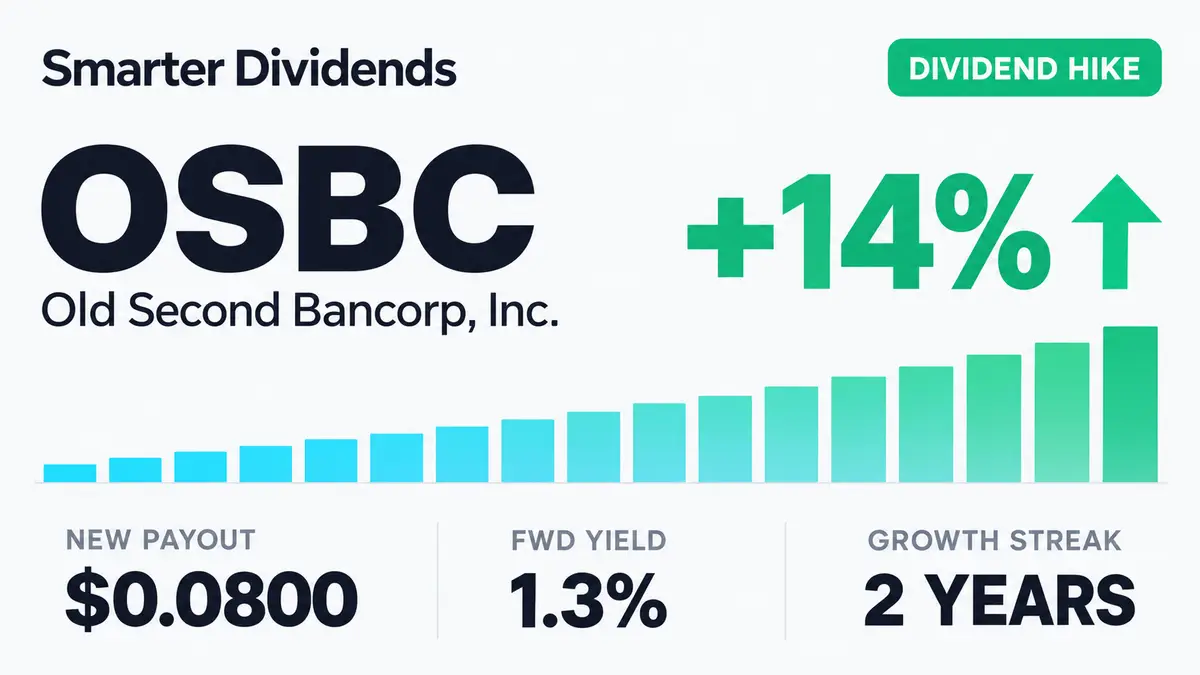
Old Second lifts its quarterly dividend 14.3% to $0.08, with a 15% earnings payout ratio and an A safety grade after stronger quarterly results.
 OSBC — Old Second Bancorp, Inc.
Key takeaways
- The quarterly dividend rises 14.3% to $0.08 a share from $0.07.
- The new $0.32 annual rate provides a 1.30% forward yield.
- The dividend uses 15% of earnings and carries an A safety grade with a score of 82.
- Old Second has increased its dividend for 2 consecutive years, with the last annual cut in 2009.
Old Second Bancorp, Inc. raised its quarterly dividend to $0.08 a share from $0.07, an increase of 14.3%. OSBC shares trade ex-dividend on October 30, 2026, with payment scheduled for November 9, 2026.
Why the dividend changed
The increase accompanied a period of stronger earnings and capital generation rather than a stock split, special dividend or merger-related adjustment. Old Second’s latest earnings release reported third-quarter net income of $28.9 million, or $0.56 per diluted share, following second-quarter net income of $28.2 million, or $0.54 per diluted share. The progression gave the board a larger earnings base from which to raise the regular distribution. Old Second’s investor-relations page lists the third-quarter release dated October 21, 2026.
Management had already signaled confidence in the bank’s capital position after the second quarter. Chairman, President and Chief Executive Officer Jim Eccher cited strong revenue, margin performance and operating efficiency, as well as a better tangible common equity capital ratio. The bank also repurchased 732,000 shares during that quarter, showing that dividends were one part of a broader capital-return program. The second-quarter earnings release said management viewed the balance sheet as well positioned for the second half.
The Bancorp Financial acquisition is an important part of the operating context. Old Second said the transaction expanded its loan portfolio and lifted net interest income, while also adding employees, operating costs and consumer-credit expenses. The acquisition therefore increased the bank’s earnings capacity but also introduced integration and credit-management demands. Old Second’s second-quarter Form 10-Q identified the acquired loan portfolio as the main source of year-over-year loan growth.
Dividend track record
The new rate extends a recent pattern of measured quarterly increases. Old Second paid $0.06 on each of the four ex-dividend dates from October 25, 2024, through July 25, 2025. It then moved to $0.07 beginning with the October 31, 2025, ex-dividend date and maintained that rate for the next three payments through July 31, 2026. The move to $0.08 is therefore another step-up in the regular distribution, not a catch-up payment or special distribution.
Full-year totals show an uneven but improving record. Annual dividends rose from $0.04 in 2020 to $0.16 in 2021, a 300.0% increase, and reached $0.20 in 2022 after rising 25.0%. The total remained unchanged at $0.20 in 2023 before increasing 5.0% to $0.21 in 2024 and 19.1% to $0.25 in 2025.
Old Second has raised its dividend for 2 consecutive years, with 43.1% annual growth over five years. That rapid growth partly reflects the low 2020 starting point. The last annual cut occurred in 2009, leaving a long interval since the previous reduction but a relatively short current growth streak.
Is the dividend covered?
The dividend consumes 15% of earnings. That leaves most reported profit available for retained capital, loan growth, credit-loss absorption and share repurchases. For a regional bank, those competing uses matter because regulatory capital and credit quality can constrain distributions even when current earnings cover the payment.
SmarterDividends rates the dividend A with a safety score of 82, meaning very safe within the 80-100 range. The grade reflects the low earnings payout and indicates a substantial current coverage cushion. It does not remove exposure to changes in credit losses, funding costs, regulatory capital requirements or acquisition performance.
Yield and valuation
At a share price of $24.41, the new $0.32 annual dividend produces a 1.30% forward yield. That is well below the Financial Services sector median forward yield of 5.83%. The increase improves cash income, but OSBC remains a lower-yielding name relative to the broader sector. A holder of 100 shares would receive $32.00 in annual dividend income at the new rate.
SmarterDividends estimates fair value at $30.28 and classifies the shares as undervalued, representing 24% upside to that estimate. The stock’s one-year price return was a 29.6% gain, which helps explain why the forward yield remains modest despite the higher distribution.
What to watch
The immediate calendar item is the October 30, 2026, ex-dividend date. Investors must own shares before that date to receive the November 9, 2026, payment under standard settlement rules.
Subsequent earnings reports will show whether the larger earnings base persists after the Bancorp Financial acquisition. Integration costs, loan growth and deposit pricing will be important because each affects retained earnings and capital available for dividends.
Credit performance also warrants attention. Old Second’s second-quarter filing described elevated net charge-offs tied largely to two previously downgraded commercial relationships, while classified assets declined. Future disclosures on nonperforming loans, charge-offs and capital ratios will provide the clearest operating context for the new payout.
OSBC dividend data
From the SmarterDividends dataset, updated daily
- Forward yield
- 1.30%
- Payout ratio
- 15%
- Growth streak
- 2 yrs
- Safety grade
- A · 82/100
| Ex-dividend date | Amount | Change |
|---|---|---|
| Jul 31, 2026 | $0.0700 | +0.0% |
| May 1, 2026 | $0.0700 | +0.0% |
| Jan 30, 2026 | $0.0700 | +0.0% |
| Oct 31, 2025 | $0.0700 | +16.7% |
| Jul 25, 2025 | $0.0600 | +0.0% |
| Apr 25, 2025 | $0.0600 | +0.0% |
| Jan 31, 2025 | $0.0600 | +0.0% |
| Oct 25, 2024 | $0.0600 | +20.0% |
Full OSBC dividend history →·Next ex-dividend date (Oct 30, 2026) →
Frequently asked questions
When is the next OSBC ex-dividend date?
The next Old Second Bancorp ex-dividend date is October 30, 2026. The payment date is November 9, 2026.
How much is the new OSBC quarterly dividend?
Old Second Bancorp’s new quarterly dividend is $0.08 a share, up from $0.07. That is a 14.3% increase.
How much is the new OSBC dividend per year?
The new annual dividend is $0.32 a share. That produces $32.00 in annual income for every 100 shares.
Is OSBC’s dividend safe?
SmarterDividends assigns the dividend an A safety grade and a score of 82, meaning very safe within the 80-100 range. The earnings payout ratio is 15%.
What is Old Second Bancorp’s dividend yield?
OSBC has a 1.30% forward yield at a share price of $24.41. The Financial Services sector median forward yield is 5.83%.
Sources
See OSBC's full dividend profile
Yield, payout, safety score, history and the next ex-dividend date.
View OSBCEvery dividend increases this month, with the data behind it: Dividend Increases, October 2026.
More dividend news
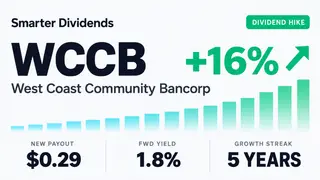
West Coast Community Bancorp Raises Dividend 16.0% to $0.29
West Coast Community Bancorp raised its quarterly dividend 16.0% to $0.29, extending a 5-year growth streak with an A safety grade and 1.83% yield.

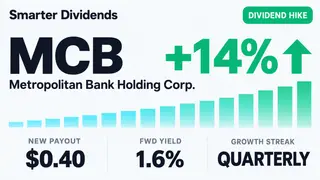
Metropolitan Bank Raises Quarterly Dividend 14.3% to $0.40
Metropolitan Bank lifts its quarterly dividend to $0.40 as stronger earnings, wider margins and solid capital support the latest payout increase.

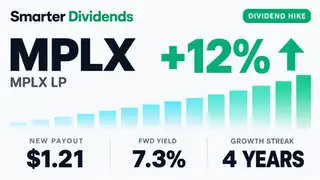
MPLX Raises Quarterly Distribution 12.5% to $1.2111
MPLX lifted its quarterly distribution to $1.2111 per unit, extending its growth streak as cash generation supports a larger capital return.

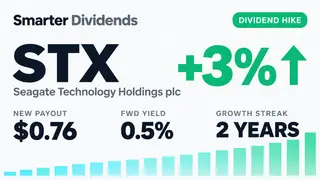
Seagate Raises Quarterly Dividend 2.7% to $0.76
Seagate raised its quarterly dividend 2.7% to $0.76 after record free cash flow, stronger demand and continued balance-sheet repair in cloud storage.

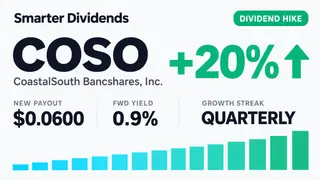
CoastalSouth Raises Quarterly Dividend 20.0% to $0.06
CoastalSouth’s quarterly payout rises to $0.06 as record earnings, loan growth and low charge-offs frame the regional bank’s dividend decision.